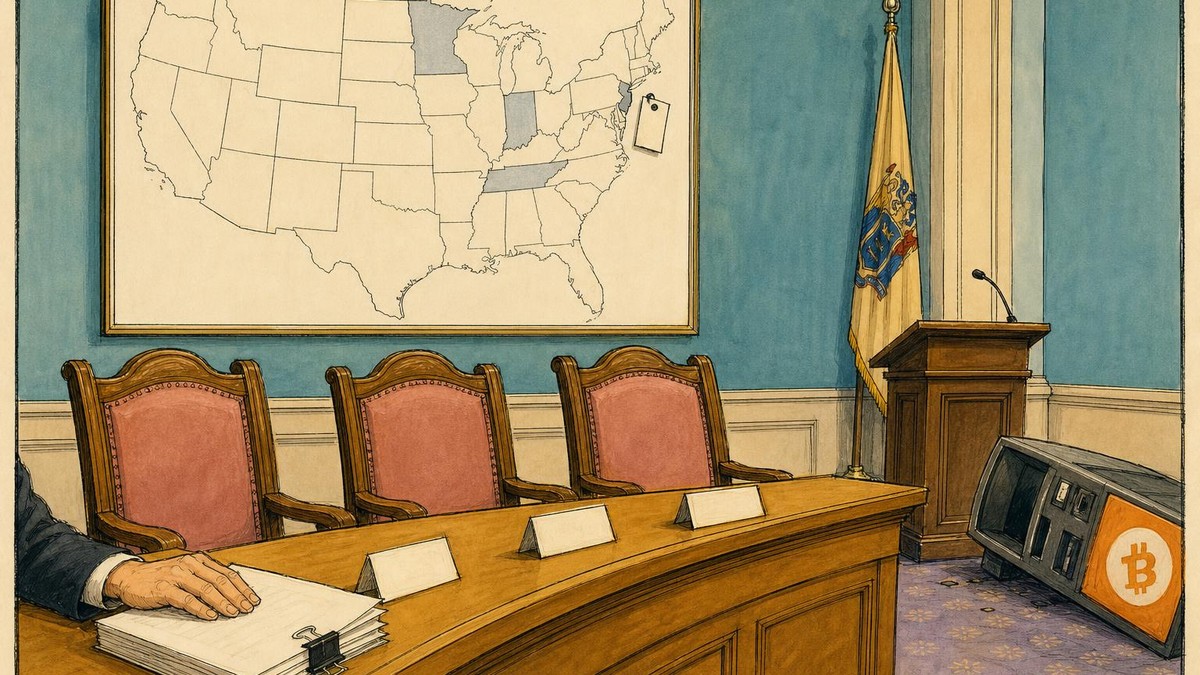
- S2141 is a pending bill, not enacted law — Sponsored by Sen. Paul Moriarty (D-4) and Sen. M. Teresa Ruiz (D-29) with seven Democratic co-sponsors, S2141 sits in the Senate Commerce Committee as an introduced bill. If enacted, it would make New Jersey the fourth state to ban cryptocurrency kiosks — following Indiana (HB 1116), Tennessee (HB 2505 / Public Chapter 766, signed April 23, 2026), and Minnesota (S.F. 3868, signed by Gov. Tim Walz on May 5, 2026). Companion bill A3244 mirrors the prohibition in the Assembly.[1]
- "No legitimate purpose" — Sen. Moriarty's stated rationale; he gives the bill a "50-50 shot" and concedes he has "a lot of education to do" with colleagues.[2]
- Penalties — Up to $10,000 first offense, $20,000 thereafter, treble damages, and AG cease-and-desist authority under the Consumer Fraud Act.[3]
- Statistical foundation — The bill cites FTC and FBI fraud-loss totals to imply Bitcoin ATMs are a uniquely fraudulent rail. The actual scam-attributable share of kiosk volume measured by independent industry sources clusters between 1% and 3%, not the 90%-range numbers driving ban legislation in other states.[4]
- Minnesota's working regulatory alternative — Minnesota's 2024 cryptocurrency-kiosk statute already imposes operator refund liability, licensure, fee disclosure, and Commerce-department oversight. CoinFlip's general counsel testified in February that fewer than 1% of CoinFlip's 12,000+ annual Minnesota transactions resulted in refund requests — the regulated channel is producing the protective outcome S2141 says it wants.[5]
- Competing NJ approach — A3386/S2957, sponsored by Asm. Sterley Stanley and Sen. Raj Mukherji, would impose mandatory scam warnings, fee disclosure, and consumer-liability disclosures while leaving regulated kiosks operating.[6]
The East Coast Joins the Anti-Kiosk Wave — and Goes Further Than Any Prior Ban
On January 9, 2026, Senators Paul Moriarty and M. Teresa Ruiz introduced Senate Bill 2141 in the New Jersey Legislature. Its premise is simple: make it a violation of the New Jersey Consumer Fraud Act for any person or business to own, operate, install, manage, or sell a cryptocurrency ATM in the state. The penalty is up to $10,000 for a first offense and $20,000 for each subsequent offense, on top of cease-and-desist orders, treble damages, and punitive damages available under the Consumer Fraud Act.[1][3]
S2141 is a proposed prohibition — and it would join a fast-moving wave of state-level bans that have moved from "introduced" to "enacted" in a matter of weeks. Indiana enacted a complete ban in 2026 after House Bill 1116 was rewritten in committee from a regulatory framework into outright prohibition. Tennessee Governor Bill Lee signed HB 2505 / Public Chapter 766 on April 23, 2026, criminalizing the operation of a virtual-currency kiosk as a Class A misdemeanor effective July 1, 2026. Minnesota's S.F. 3868 was signed into law by Governor Tim Walz on May 5, 2026 — one day before this article published — completing a third state ban in the current cycle.[7][8][9]
If enacted, S2141 would make New Jersey the fourth state in this cycle to ban kiosks. What distinguishes the New Jersey proposal is the breadth of conduct it prohibits and the enforcement mechanism it borrows. Unlike the Indiana, Tennessee, and Minnesota statutes, S2141 routes the violation through New Jersey's Consumer Fraud Act — which carries treble damages, attorneys' fees, and a private right of action for any "injured party," in addition to AG cease-and-desist authority and per-offense civil penalties. It also reaches the sale of a kiosk, not just its operation. The Crypto Council for Innovation's state and local government affairs lead, Peter Herzog, has named S2141 as the measure the industry is "most wary" of.[7]
Sen. Moriarty has been characteristically blunt about his motivation: "I don't believe there's any legitimate purpose for bitcoin ATM machines. None. And the people who are operating these networks are profiting off the pain and suffering of victims all across America." He estimates the bill has "a 50-50 shot" at passing and acknowledges he has "a lot of education to do" with his colleagues.[2]
The candor about the education gap is appreciated. It is also revealing. New Jersey is being asked to enact a prohibition built on the same pattern that produced the Indiana, Tennessee, and Minnesota bans: emotionally devastating victim testimony, headline fraud-loss totals, and acknowledgments by sponsors that the underlying product is not well-understood. We documented that pattern in Minnesota's HF 3642 hearing in February, where the bill's House sponsor openly admitted she did not understand Bitcoin while sponsoring its prohibition. We documented it in Indiana's pivot from licensing to prohibition after a single hearing. S2141 follows the same template — and goes further than any of them in scope.
What S2141 Actually Does
The bill amends the Consumer Fraud Act (P.L.1960, c.39) to make it an unlawful practice for any business entity to:[3]
- Own a cryptocurrency ATM in New Jersey
- Control or install such a machine
- Manage such a machine
- Sell or offer to sell a cryptocurrency ATM in New Jersey
The definition is broad: any "physical, internet-connected kiosk that allows a user to buy, sell, send, or receive cryptocurrency by depositing money using a debit card, credit card, or cash." There is no carve-out for licensed operators, no carve-out for FinCEN-registered Money Services Businesses, no carve-out for kiosks that comply with state money-transmitter laws, and no carve-out for kiosks that have produced no consumer harm in the state. Compliance is not a defense. The act of operation is the violation.
| Offense | Penalty |
|---|---|
| First offense | Up to $10,000 |
| Subsequent offenses | Up to $20,000 each |
| Additional remedies | AG cease-and-desist, punitive damages, treble damages, costs |
Source: New Jersey S2141 (2026-2027 Session), as introduced
S2141 is a re-introduction of last session's S3694/A4880, which did not advance. The bill currently sits in the Senate Commerce Committee. The companion measure A3244 mirrors the same prohibition in the Assembly. The NCSL's 2026 cryptocurrency legislation tracker lists S2141 as pending.[1][10]
The Competing New Jersey Approach: Regulate, Don't Prohibit
What is striking about the New Jersey debate is that S2141 is not the only proposal on the table. Assemblyman Sterley Stanley (D-East Brunswick) and Sen. Raj Mukherji (D-Jersey City) have introduced a competing pair of bills — A3386 and S2957 — that would permit licensed kiosks to continue operating under tighter rules: mandatory scam warnings on machines, disclosure that virtual currency is not legal tender, and disclosure of customer liability for unauthorized transactions.[6]
The Stanley/Mukherji approach is the same path the majority of states have taken in the current legislative cycle: licensing, transaction limits, fee caps, fraud warnings, blockchain analytics requirements, and operator refund liability. Vermont and Minnesota's 2024 statute imposed protections of this kind. Florida, Illinois, and Massachusetts require analytics-driven fraud prevention. Colorado would impose full operator refund obligations on fraudulent transactions. Virginia enacted a comprehensive 28-section licensing regime in April 2026 with an 18% fee cap, mandatory blockchain analytics screening, and a 90-day scam refund window.[11]
S2141 stands apart from that regulatory consensus. It does not impose stricter conditions on operators. It eliminates them. The choice in New Jersey is therefore between joining the small minority of states that have prohibited the regulated channel — Indiana, Tennessee, and Minnesota — or joining the majority that have built and continue to refine a regulatory regime. S2141 itself offers no middle option.
The Statistical Foundation Is the Same Funnel — and It Is Wrong
S2141's legislative findings rest on the same statistical foundation that has driven every other 2025–2026 anti-kiosk bill: FTC Consumer Sentinel Network reports of $110 million in 2023 losses linked to Bitcoin ATMs, FBI figures totaling $5.6 billion in cryptocurrency fraud in 2023, and the assertion that nearly half of crypto-kiosk complaints to the FBI come from people over 60. The contemporaneous figure now circulating in legislative debate — including the Minnesota debate that produced S.F. 3868 — is the FBI's reported $240 million in cryptocurrency-kiosk-related losses in just the first six months of 2025, a number S2141's findings predate but that any honest read of the current evidence has to confront.[3]
These are real numbers. They describe a real and growing harm. But the FBI's $240 million H1 2025 figure — and the older numbers in S2141's findings — are numerator measurements, not share measurements. They tell you the dollar volume of reported losses; they do not tell you what fraction of total cash-to-Bitcoin kiosk activity that volume represents. In the form they are typically presented to legislatures, they are the wrong measurement for the question being asked.
We covered this in detail in "The Denominator Scam" last week: the headline percentages legislators repeat — Iowa's 98%, the District of Columbia's 93%, AARP's 92% — are not measurements of how Bitcoin ATMs are used. They are enforcement-funnel statistics, drawn from outreach to suspected scam victims and complaint pools. The denominator is the population of people already flagged as likely victims. Of course the numerator is high. By construction, the only people in the sample are the ones who were defrauded.[12]
When you measure the actual market — total transaction volume — the picture changes by an order of magnitude:[5]
| Source | Method | Scam-Attributable Share |
|---|---|---|
| FBI IC3 (2025 Annual Report) | $333.5M reported losses ÷ $11.37B in measured cryptocurrency activity | 2.93% |
| TRM Labs (2023 industry report) | On-chain blockchain analytics across cash-to-crypto industry | 1.2% |
| CoinFlip Minnesota (testimony, Feb 2026) | Refund requests ÷ 12,000+ annual Minnesota transactions from 8,000 customers | < 1% |
| "As high as 90%" (typical legislative finding) | Outreach to suspected victims and complaint pools | Methodologically unsound for market-share inference |
Sources: FBI IC3 2025 Annual Report; TRM Labs 2023 industry report; Larry Lipka, General Counsel, CoinFlip, testimony before Minnesota House Commerce Finance and Policy Committee, February 26, 2026
S2141 quotes the FTC and FBI numbers. It does not quote any of these full-market measurements. A bill that proposes the most aggressive remedy in the legislative toolkit — extinction of an entire compliant industry — should be working from a market measurement, not an enforcement funnel.
The Working Regulatory Alternative Already Exists — and Minnesota Is About to Dismantle It
The empirical answer to S2141 is that the regulatory regime its findings describe — operator-side fraud prevention, transaction-level intervention, refund liability for affected customers — is not hypothetical. Minnesota enacted it in 2024.
Minnesota's 2024 cryptocurrency-kiosk consumer-protection statute imposes operator refund liability on the kiosk operator when a customer is the victim of a scam, alongside fee and rate disclosure, transaction caps for new customers, daily limits, licensure under the Department of Commerce, and a designated compliance officer at each operator. The statute makes the operator — not the State, not the victim — bear the cost of making the customer whole, and that is the operative legal mechanism that turns scam attempts into recoveries before funds leave operator control.[5]
The empirical evidence that this regime is working comes from the operators who are subject to it. CoinFlip's general counsel, Larry Lipka, testified before the Minnesota House Commerce Finance and Policy Committee in February 2026 that CoinFlip processes more than 12,000 Minnesota transactions per year from approximately 8,000 customers, and that fewer than 1% of those transactions resulted in refund requests. That figure is not an enforcement-funnel statistic. It is the actual user-population behavior of a licensed operator under the existing 2024 law — the population the bill characterizes as predominantly fraudulent.[5]
The regime S2141's findings describe — operator-side fraud detection, intervention, and refund liability — already exists in Minnesota's 2024 statute, and the operators subject to it report a refund-request rate below 1% of total transaction volume. The protective outcome S2141 says it wants is the outcome a properly-built regulatory framework is producing in the state with the most developed cryptocurrency-kiosk consumer-protection law in the country.[5]
What is striking — and what New Jersey lawmakers should weigh carefully before voting on S2141 — is that Minnesota's S.F. 3868, now signed into law, will eliminate the very operators on whom that 2024 refund-liability mechanism depends. By prohibiting the licensed channel, the ban does not transfer the refund liability to a peer-to-peer cash seller in a parking lot. It simply extinguishes the liability, along with the licensure, recordkeeping, fee disclosure, and Commerce-department oversight that depend on a licensed counterparty. The Indiana and Tennessee bans do the same. S2141 would do the same.
The implication for New Jersey is direct. The outcome S2141's findings ask for — New Jerseyans not losing money to social-engineering scams at kiosks — is the outcome a properly-built regulatory regime is capable of producing. The bill is asking the Legislature to replace that regulatory tool with a prohibition before New Jersey has even tried it. There is no remaining gap in protection that prohibition would fill — and prohibition would, by design, eliminate the operator on whom the refund liability falls.
What a Ban Actually Does to the People It Claims to Protect
If S2141 passes, the demand for cash-to-Bitcoin conversion in New Jersey does not disappear. The bill does not address that demand. It does not address online cryptocurrency exchanges. It does not address peer-to-peer markets. It addresses one channel — the regulated, licensed, KYC-compliant, refund-liable channel — and removes it.
Measured against the goals S2141's findings cite, here is what a ban actually does:[8]
- Reduce fraud losses? No. The social-engineering scams driving losses pre-date Bitcoin ATMs and migrate freely between rails — gift cards, wire transfers, payment apps, money mules. Closing one rail does not erase the loss; it migrates the loss. AARP itself has acknowledged that gift cards, wire transfers, and payment apps were the preferred scam payment methods before scammers were pushed toward crypto kiosks.
- Protect victims? No. With kiosks banned, victims of social-engineering scams will be directed to meet strangers from Craigslist, Telegram, and LocalBitcoins-style forums to hand over cash in parking lots — without cameras, receipts, blockchain anchoring, transaction limits, KYC, operator hotlines, or compliance-driven holds. Every consumer-protection feature the regulated channel provides disappears.
- Help law enforcement? The opposite. Licensed kiosk operators are FinCEN-registered Money Services Businesses that file SARs, retain video, log wallet destinations, respond to subpoenas, and proactively notify local agencies of fraud patterns. Peer-to-peer cash sellers do none of that. Banning kiosks blinds investigators to the very transactions they want to trace.
- Lower consumer cost? No. Cutting supply and competition raises prices. Unlicensed peer-to-peer sellers charge higher premiums over licensed kiosk rates — with no fee disclosure, no recourse, and no protection if the seller disappears with the cash.
- Improve public safety? No. In-person cash-for-Bitcoin meetups have a long, documented history of robberies, assaults, and homicides — exactly the harms a regulated, well-lit, camera-monitored kiosk in a trusted retail location is designed to prevent.
Cash-to-Bitcoin demand in the United States is not shrinking — it is growing. Bitcoin's adoption curve continues to rise, household ownership has expanded year over year, and cash remains the preferred payment method for tens of millions of Americans, particularly in unbanked, underbanked, immigrant, tribal, and remittance-sending communities. Adults who prefer cash, who lack bank accounts, who do not want to link a bank to a crypto exchange, who send remittances, or who simply do not trust online platforms will not stop wanting Bitcoin because the New Jersey Legislature said so. They will buy it from someone.
The choice is not between Bitcoin ATMs and no Bitcoin ATMs. It is between a regulated, supervised counterparty and an unregulated one. S2141, as written, eliminates the first while leaving the second untouched.
The People S2141 Says It Protects Are the People S2141 Hurts
The bill's findings emphasize harm to elderly New Jerseyans — a real and serious harm that any responsible operator and any honest publication should acknowledge. But the populations that disproportionately use cash-to-Bitcoin kiosks are the same populations any prohibition will most harm:
- The unbanked and underbanked. An estimated 4.5% of New Jersey households are unbanked or underbanked. For these households, a bank-linked exchange is not an option — by definition. A kiosk is.
- Immigrant and remittance-sending communities. Cash-in, crypto-out is a working remittance corridor for sending value across borders without the friction or refusal that hits cash-only customers at traditional money transmitters.
- Cash-economy workers. Day laborers, gig workers, and small-business operators who are paid in cash and want to participate in a financial product the rest of the country has access to.
- Older customers who do not trust online platforms. The same population the bill names as victims often chooses kiosks specifically because they do not want to link a bank account to a crypto exchange or navigate an online onboarding flow. Removing the in-person option does not push them online. It pushes them to a Telegram seller.
That is the deepest irony of S2141. The bill takes the consumer-protection framework that has demonstrably worked in Minnesota — operator refund liability, licensure, fee disclosure, transaction limits, Commerce-department oversight — and replaces it with the one regime that, by construction, has none of those protections: an unregulated peer-to-peer market.
The Regulation Path Is Already Well-Mapped
None of this means New Jersey should do nothing. The existing 2021 New Jersey Commission of Investigation report flagged that some kiosk operators in the state were "not consistently or committedly complying with reporting mandates." That finding describes a problem of operator compliance — not a problem that requires extinguishing the entire compliant industry alongside the non-compliant fringe.[13]
The regulatory toolkit available to New Jersey is well-developed and proven:
- Operator refund liability for scam-driven authorized transactions, modeled on Minnesota's 2024 statute. This is the legal mechanism that places the cost of fraud loss on the licensed operator rather than the victim, and that converts compliance teams into the front line of consumer protection rather than a back-office function.
- Mandatory licensing under the Department of Banking and Insurance, with examination authority and license-revocation powers for non-compliant operators — the same authority Iowa's Attorney General used to sue Bitcoin Depot and CoinFlip directly, without the need for prohibition.
- Transaction caps for new customers, daily limits, and cooling-off windows on first transactions — the layer of friction social-engineering scams cannot survive.
- Fee and rate disclosure in plain language at the kiosk before the transaction is completed.
- Mandatory blockchain analytics and KYC, modeled on Florida, Illinois, and Massachusetts requirements.
- Designated compliance officers and direct law-enforcement liaison contacts at each operator.
This is the path A3386/S2957 contemplates. It is the path 14 other state legislatures are converging on. It is the path the rest of the country is already walking — including the version Minnesota walked in 2024, which is now producing $0-lost outcomes in operator filings.
S2141 does not strengthen that regime. It eliminates it. By prohibiting the regulated channel, the bill removes the licensed operators on whom refund liability would fall, removes the licensure regime, removes the Commerce or Banking-department oversight, removes the SAR pipeline, and removes the auditable transaction record. It substitutes a parking-lot Telegram economy in their place. That is a step backward from any New Jersey consumer-protection regime, not forward.
The Honest Question for the New Jersey Legislature
The case for action is real. The case for this action is not.
Sen. Moriarty has been candid that he believes there is "no legitimate purpose" for Bitcoin ATMs. That is a value judgment, not a fact-finding. The full-market FBI IC3 measurement (2.93%), the TRM Labs blockchain-analytics measurement (1.2%), and a major operator's testimony that fewer than 1% of its 12,000-plus annual Minnesota transactions resulted in refund requests are all incompatible with that judgment. So is the legitimate, repeat-customer base that drives the overwhelming majority of measured kiosk transaction volume.[4][5]
Moriarty also says he has "a lot of education to do." He is right. The honest thing for the Legislature to do is to do that education before passing one of the broadest anti-Bitcoin-ATM laws in the country — not after. The honest question for the Senate Commerce Committee is the one the bill itself does not ask: before banning the regulated channel, identify any specific provision of a properly-built regulatory regime that would not produce the protective outcome S2141 says it wants — and strengthen that provision instead.
Targeted enforcement against specific bad operators — under the New Jersey Consumer Fraud Act, the Division of Consumer Affairs, the Department of Banking and Insurance's money-transmitter authority, and federal AML obligations — is consumer protection. Industry-wide prohibition built on enforcement-funnel statistics, layered on top of demand that will not disappear, is something else. It is the elimination of a working channel and the displacement of its users to a worse one.
New Jersey can become the fourth state to ban Bitcoin ATMs — joining Indiana, Tennessee, and Minnesota in dismantling the regulated channel. Or it can become the next state to regulate them properly, joining Vermont, Florida, Illinois, Massachusetts, Colorado, and Virginia. Only one of those two paths protects the people the bill names.
Sources & References
- New Jersey Senate Bill S2141 (2026-2027 Regular Session), introduced by Sens. Paul Moriarty (D-4) and M. Teresa Ruiz (D-29) with co-sponsors Stack, Diegnan, McKnight, Turner, Greenstein, Cryan, and Wimberly; Assembly companion A3244 sponsored by Asm. Dan Hutchison. Last session prior version: S3694/A4880.
- Sen. Paul Moriarty, public statements on S2141. "I don't believe there's any legitimate purpose for bitcoin ATM machines. None. And the people who are operating these networks are profiting off the pain and suffering of victims all across America." Estimates the bill at "a 50-50 shot."
- State of New Jersey Senate Bill 2141 — current version of text, as introduced. Penalties under N.J.S.A. 56:8-1 et seq. (Consumer Fraud Act).
- FBI Internet Crime Complaint Center, 2025 Annual Report (full-market measurement: $333.5M cryptocurrency-kiosk-related losses out of $11.37B total cryptocurrency activity measured = 2.93%); TRM Labs 2023 industry report (1.2% scam-attributable share of cash-to-crypto industry).
- Minnesota cryptocurrency-kiosk consumer-protection statute, enacted 2024 (operator licensing, refund liability, fee and rate disclosure, transaction caps for new customers, daily transaction caps, designated compliance contact). CoinFlip data point from public testimony: Larry Lipka, General Counsel, CoinFlip, before the Minnesota House Commerce Finance and Policy Committee, February 26, 2026 — fewer than 1% of CoinFlip's 12,000+ annual Minnesota transactions from approximately 8,000 customers resulted in refund requests. Hearing video.
- New Jersey Assembly Bill A3386 / Senate Bill S2957, sponsored by Asm. Sterley Stanley (D-East Brunswick) and Sen. Raj Mukherji (D-Jersey City). Imposes mandatory scam warnings, virtual-currency disclosure, and consumer-liability disclosure on kiosk operators while leaving operations lawful.
- Indiana House Bill 1116, enacted 2026 — originally proposed as a regulatory framework, amended in committee to a complete prohibition. Coverage: "Indiana Senate Committee Votes to Ban ATMs Outright", BitcoinATM.news. Peter Herzog, Crypto Council for Innovation, public statements naming S2141 as the legislative proposal the industry is "most wary" of, and noting that prohibition risks "disrupting financial markets and preventing everyday users from accessing their funds."
- Tennessee House Bill 2505 / Public Chapter 766, signed by Governor Bill Lee on April 23, 2026, effective July 1, 2026. Makes installation, permission, or operation of a virtual-currency kiosk a Class A misdemeanor. Passed House 94-0 and Senate 32-0. Coverage: "Tennessee Criminalizes Bitcoin ATMs," BitcoinATM.news, April 25, 2026.
- Minnesota Senate File 3868, signed into law by Governor Tim Walz on May 5, 2026. Senate companion to House File 3642 covered in "The Scam Economy and Bitcoin ATMs: Why Banning a Payment Rail Won't Solve a $119 Billion Problem," BitcoinATM.news, March 12, 2026 — including Rep. Erin Koegel's acknowledgment that she did not fully understand Bitcoin while sponsoring its prohibition. FBI cryptocurrency-kiosk loss figure ($240 million in the first six months of 2025) cited in Minnesota legislative debate over S.F. 3868.
- National Conference of State Legislatures, 2026 cryptocurrency legislation tracker, listing S2141 as pending.
- State legislative tracking, 2025–2026 cycle: Vermont and Minnesota's 2024 statute (registration/licensure/refund liability); Florida, Illinois, Massachusetts (blockchain analytics requirements); Colorado (operator refund obligations); Virginia HB 665 / Public Chapter 654 of 2026 (28-section licensing regime, 18% fee cap, blockchain analytics screening, 90-day scam refund window, signed April 13, 2026).
- "The Denominator Scam: How Iowa's 98%, DC's 93%, and AARP's 92% 'Scam' Stat Got Laundered Into a Push for Bitcoin ATM Bans," BitcoinATM.news, April 30, 2026.
- State of New Jersey Commission of Investigation, 2021 report on cryptocurrency ATM operators — finding that operators were "not consistently or committedly complying with reporting mandates" and that kiosks remained "vulnerable to abuse and criminal intrusion."