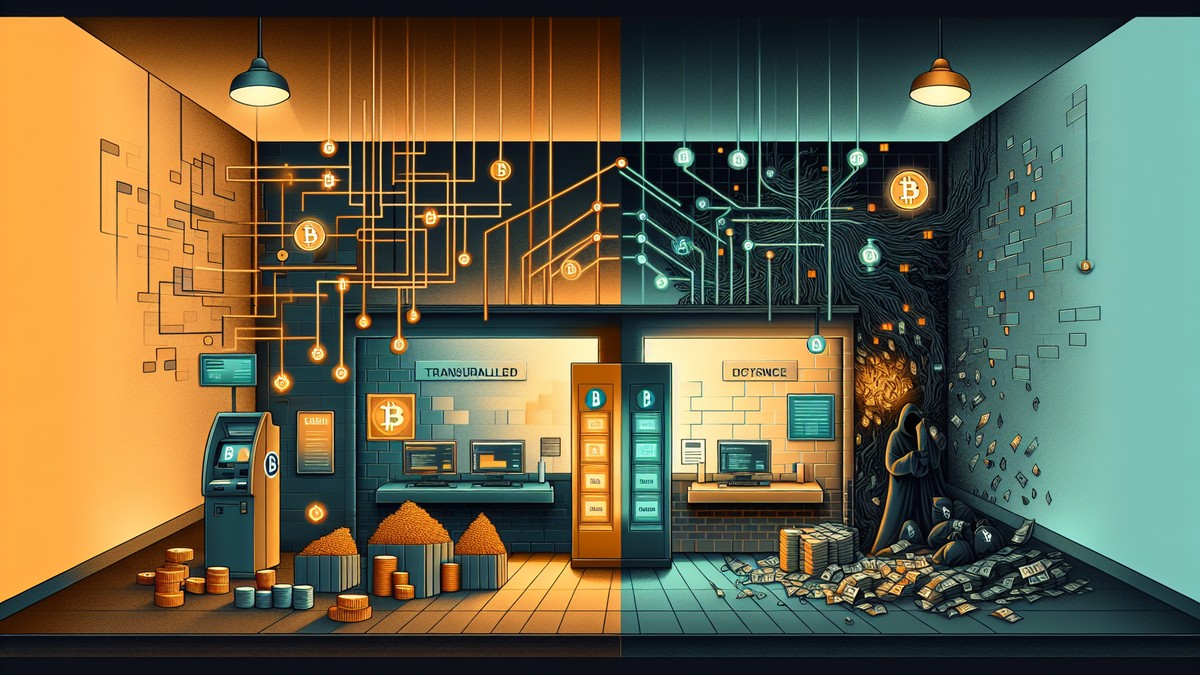
- HF 3642 — Minnesota bill to ban all 427 Bitcoin ATMs statewide, heard before the House Commerce Finance and Policy Committee on February 26, 2026
- $333M in reported fraud — FBI-reported Bitcoin ATM fraud losses nationally in 2025 represent just 0.28% of the $119 billion true scam economy estimated by the Consumer Federation of America
- CoinFlip testimony — General Counsel Larry Lipka highlights that Bitcoin ATM operators face an unprecedented requirement to refund authorized transactions — something no other financial product in the U.S. is asked to do
- Legislative ignorance — bill sponsor Rep. Koegel admits she doesn't understand Bitcoin; another legislator claims "Bitcoin is the opposite of transparent"
- Bans push users to unregulated P2P — eliminating KYC-compliant, traceable kiosks drives demand to dangerous peer-to-peer cash meetups invisible to law enforcement
Legislators Are Targeting What They Don't Understand — And It Shows
On February 26, 2026, Minnesota Representative Erin Koegel brought House File 3642 before the House Commerce Finance and Policy Committee, proposing a statewide ban on all 427 licensed Bitcoin ATMs. The bill's stated purpose: to protect consumers — particularly seniors — from scams facilitated through cryptocurrency kiosks. The Minnesota Department of Commerce "strongly supports" the measure.[1][2][3]
On the surface, the impulse is understandable. The FBI reported $333 million in cryptocurrency kiosk-related fraud losses nationally in 2025, with adults over 60 accounting for more than 85% of reported losses. These are real victims with devastating stories. A Woodbury woman, already food- and housing-insecure, gave 50% of her monthly income to scammers over eight months through a gas station kiosk. An elderly St. Cloud resident lost $80,000.[4][5][1]
There is something Orwellian about the Minnesota Department of Commerce — the state agency whose name literally means "the facilitation of trade" — lending its full-throated support to a bill that would ban an entire category of lawful commerce in the state. The Department of Commerce supporting the prohibition of commerce. The doublespeak writes itself.
CoinFlip's General Counsel Larry Lipka put a finer point on it during testimony, directly challenging the regulator: if operators are truly as non-compliant as the hearing suggested, then the Department of Commerce should do its job and enforce against those specific operators. Minnesota already has the regulatory tools. The state enacted a cryptocurrency kiosk consumer protection law in 2024 that gives regulators broad authority over operator conduct. If operators are violating that law, enforce it. Bring enforcement actions. Revoke licenses. The existence of bad actors in a regulated industry is an argument for better enforcement — not for banning the industry and punishing compliant operators alongside non-compliant ones.[1][9]
But beneath the emotional urgency lies a bill built on a foundation of legislative ignorance about the technology it seeks to eliminate, the scale of the problem it claims to address, and the consequences of the solution it proposes.
"Who Knows What Crypto Is Anyway?"
Rep. Koegel herself — the bill's sponsor and co-chair of the Commerce Committee — openly admitted during testimony that she doesn't fully understand Bitcoin. This is not a minor detail. The person leading the charge to ban a financial technology product in the state of Minnesota does not, by her own admission, understand how it works.[6]
What made this especially striking was the framing. Having watched the hearing, one of the most bizarre moments was Koegel bookending the proceedings with calls for "good faith" discussion of the issue. She opened by asking participants to approach the topic thoughtfully and closed by thanking everyone for the good-faith dialogue. Yet here was a legislator who, by her own admission, had little to no understanding of the technology she had authored an extreme bill to ban — not regulate, not restrict, but eliminate entirely from her state. Bringing HF 3642 before the committee without first investing the effort to understand the basic mechanics of the product you're proposing to prohibit is not good faith. It is the opposite.
She is not alone. During committee proceedings, another legislator asserted that "Bitcoin is the opposite of transparent." This statement is not merely wrong — it is the precise inversion of reality. Bitcoin operates on a global public ledger. Every transaction ever made is permanently recorded and visible to anyone in the world. Wallet balances are public. Transaction flows are traceable. Blockchain analytics firms like Chainalysis and Elliptic have built entire businesses on Bitcoin's radical transparency, and law enforcement agencies worldwide use these tools daily to track and recover illicit funds.[7]
There is perhaps no more transparent payment system in the history of finance than a public blockchain. When a victim sends cash through a Bitcoin ATM to a scammer's wallet, that wallet address, the amount, and the timestamp are permanently etched into an immutable public record. Compare this to cash stuffed in an envelope and mailed overseas, or gift cards whose redemption codes vanish the moment they're read over the phone. Bitcoin's traceability is precisely why the FBI, FinCEN, and international law enforcement have been able to identify and quantify these losses at all.[8]
That legislators are writing bans based on a fundamental misunderstanding of the product they're banning should alarm everyone — regardless of their position on cryptocurrency.
$333 Million Sounds Enormous — Until You See the Denominator
The $333 million figure in FBI-reported Bitcoin ATM fraud losses is the centerpiece of every legislative push to ban kiosks. It is presented as a crisis so severe that only a complete prohibition can address it. But what does $333 million actually represent in the broader scam economy?[5][10][4]
According to the Consumer Federation of America's March 2026 report, The Scam Economy: The True Cost of Online Scams and Crimes in America, the estimated true cost of online scams and crimes in the United States is $119 billion annually. This figure applies the Bureau of Justice Statistics' conservative 14% reporting rate — meaning for every fraud reported to law enforcement, roughly six go unreported — to the FBI IC3's $16.6 billion in reported 2024 losses.[11]
Even using only the reported FBI IC3 number of $16.6 billion, Bitcoin ATM fraud at $333 million represents approximately 2% of reported online fraud losses. Against the CFA's estimated true losses of $119 billion, Bitcoin ATM fraud represents roughly 0.28% of the actual scam economy.
| Metric | Amount | Bitcoin ATM Share |
|---|---|---|
| FBI IC3 Reported Losses (2024) | $16.6 billion | ~2.0% |
| CFA Estimated True Losses (2024) | $119 billion | ~0.28% |
| Investment Scams Alone (Reported) | $6.6 billion | ~5.0% |
| Investment Scams Alone (Est. True) | $46.6 billion | ~0.7% |
| Meta's Estimated Scam Ad Revenue | ~$16 billion | ~2.1% |
Sources: FBI IC3 2024 Report; Consumer Federation of America, "The Scam Economy," March 2026; Reuters, November 2025
The CFA report documents that investment scams alone — driven primarily by cryptocurrency schemes that have nothing to do with physical kiosks — account for $6.6 billion in reported losses, estimated at $46.6 billion in true losses. Business email compromise accounts for another $2.8 billion reported, $19.7 billion estimated. Tech support scams: $1.5 billion reported, $10.4 billion estimated.[11]
Meanwhile, the same CFA report highlights that Meta platforms are estimated to earn approximately $16 billion annually from ads promoting scams and banned goods, according to internal documents reviewed by Reuters — and Meta's platforms were involved in approximately one-third of successful scams in the United States. The BBB's 2024 Scam Tracker found that the top three platforms associated with scams are all Meta-owned: Facebook (57%), Instagram (22.4%), and WhatsApp (7.9%).[11]
No legislator in Minnesota — or anywhere — is proposing to ban Facebook.
Jumping straight to a ban on a payment rail that accounts for a fraction of a percent of total scam losses, while the platforms where these scams originate and are monetized face no comparable accountability, is not proportionate policy. It is targeting the most visible, least powerful actor in the scam supply chain.
"We Are the Only Financial Services Product... That Needs to Refund Authorized Transactions"
Larry Lipka, General Counsel for CoinFlip, provided some of the most incisive testimony during the hearing. His core argument deserves attention:[12][7]
"While I understand that scams are a problem, scams are a problem everywhere in this country. They are a problem for crypto kiosks, they are a problem for wire transfers, and they are a problem for gift cards. But no one is here today saying we should ban exchanges or gift cards or wire transfers because scammers use them."
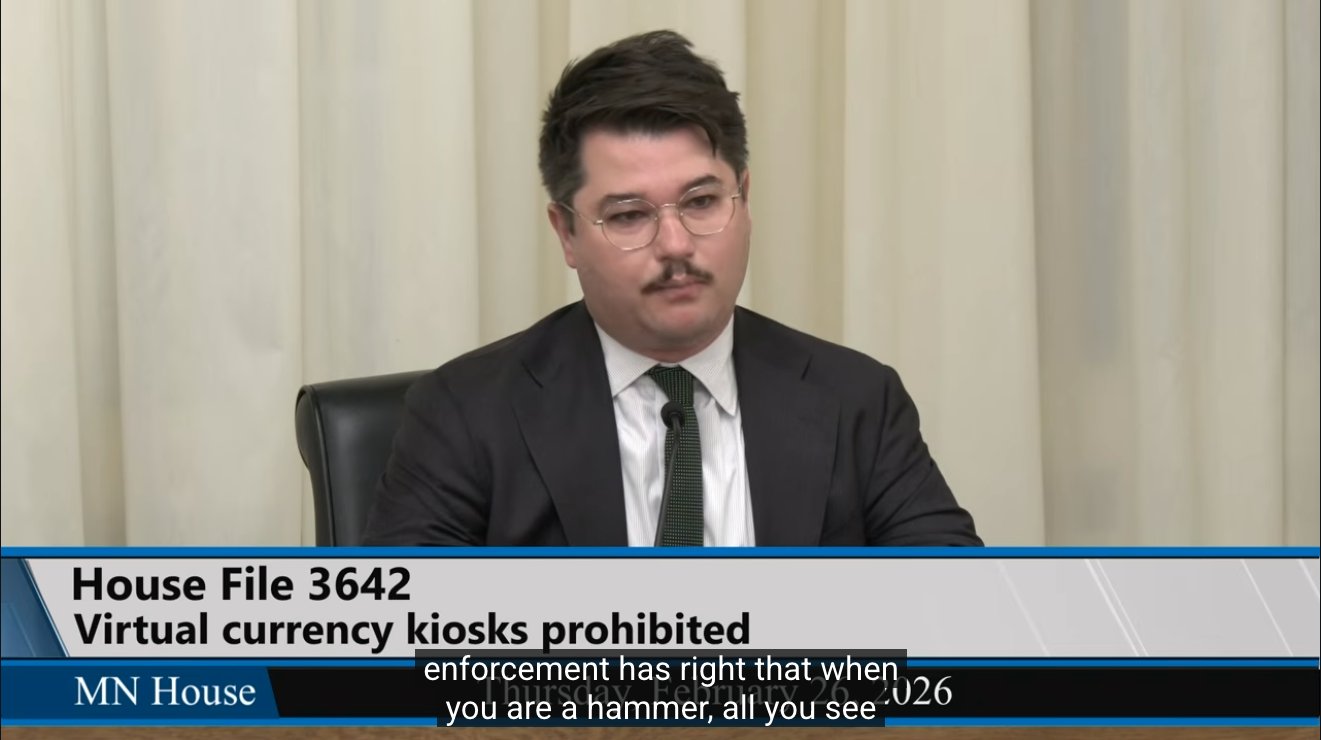
Lipka's most powerful point cuts to the heart of the regulatory absurdity: "We are the only financial services product in the entire United States... that needs to refund authorized transactions." No wire transfer service is required to do this. No gift card issuer. No bank. No money transmitter of any kind. Not Western Union. Not MoneyGram. Not Zelle. Not Venmo. Not PayPal.[13][14]
This statement deserves serious reflection. Under federal Regulation E, financial institutions are required to refund unauthorized transactions — charges or transfers the customer did not approve. This is the bedrock of consumer protection in electronic funds transfer. If someone steals your debit card and makes a purchase, your bank reverses it.
But Minnesota's 2024 law — and similar bills in Hawaii, Rhode Island, and other states — goes beyond anything Reg E requires. It mandates that Bitcoin ATM operators refund transactions that the customer voluntarily authorized. The customer walked to the kiosk. The customer inserted cash. The customer confirmed the transaction. The customer received cryptocurrency. And the operator must give the money back — while the customer isn’t required to return the purchased bitcoin.[15][13]
No wire transfer service is required to do this. No gift card issuer. No bank. No money transmitter of any kind. The Bitcoin ATM industry in Minnesota has been asked to do something that goes beyond anything required of any other consumer financial services product in the entire history of the United States — and arguably the world.[14][13]
As Lipka testified regarding Rhode Island's similar proposal: "If we must refund victims' authorized transactions, it results in a double loss to us — both the crypto we purchased and sent per the customer's instructions, and the cash we must return." The cryptocurrency, once sent to the blockchain, cannot be retrieved by the operator. The operator purchased it, delivered it per the customer's instructions, and now must also refund the cash. It is equivalent to requiring a car dealer to refund the purchase price of a vehicle that the buyer then drove off a cliff.[13]
And when these unprecedented requirements still don't satisfy legislators, the response isn't to examine whether the requirements were reasonable in the first place — it's to skip directly to a total ban.
The Ignorance Problem Is Not Incidental — It Is the Central Issue
A recurring theme throughout these legislative proceedings is not merely that lawmakers are uninformed, but that their ignorance is actively shaping policy. This is not a partisan critique. Rep. Tim O'Driscoll, the Republican co-chair, acknowledged that "Democrats and Republicans want a solution." The bipartisan consensus is genuine. But bipartisan ignorance does not produce good law.[16]
Consider what the committee heard and what it didn't:
What legislators heard: Emotionally devastating victim testimony. Law enforcement describing cases they couldn't solve. A Commerce Department citing $333 million in national losses.
What legislators apparently didn't hear — or didn't understand:
- That Bitcoin's public blockchain is one of the most powerful law enforcement tools ever created for tracking financial flows
- That the $333 million represents less than one-half of one percent of estimated true scam losses
- That social media platforms — where these scams originate — face virtually no comparable regulatory pressure
- That their own 2024 law imposed requirements with no precedent in consumer financial services
- That banning kiosks doesn't ban the demand for cash-to-Bitcoin conversion — it merely pushes it underground
The CFA report documents that the GASA 2025 survey found 81% of scam attempts in the U.S. occurred on platforms with direct messaging functions, and social media was identified as a contact channel in 32% of scam attempts. The scam begins on Facebook or in a phone call. The kiosk is merely the last mile — one of many possible last miles — where the victim converts cash to a payment the scammer requested.[11]
What Happens When You Ban the Kiosk
If Minnesota bans all 427 Bitcoin ATMs, will the demand for cash-to-Bitcoin conversion disappear?
It will not.
CoinFlip alone processes 12,000 transactions per year from 8,000 customers in Minnesota. These customers — the overwhelming majority of whom are legitimate users, not scam victims — will still want to buy Bitcoin with cash. Lipka testified that less than 1% of CoinFlip's Minnesota transactions resulted in refund requests.[1]
Where will these users go?
The answer is peer-to-peer transactions. Cash meetups arranged through online forums, social media, or messaging apps. Two strangers meeting in a parking lot to exchange cash for cryptocurrency.
These transactions are:
Outside the eye of law enforcement. No KYC. No SAR filing. No ID verification. No blockchain analytics screening. No transaction records submitted to any regulatory body. If a scam victim is directed to buy Bitcoin through a peer-to-peer meetup, there is no operator to file a report, no compliance team to flag suspicious activity, no hold period to reverse the transaction.
Fraught with counterparty risk. When you meet a stranger to exchange cash for Bitcoin, you have no guarantee they will send the Bitcoin after receiving your cash. You have no guarantee the cash isn't counterfeit. You have no recourse if the transaction goes wrong. There is no customer service line to call.
Physically dangerous. Cash transactions between strangers create robbery risks for both parties. Bitcoin meetup robberies have been documented nationwide. A regulated kiosk in a gas station, monitored by security cameras and operating during business hours, is categorically safer than a parking lot transaction with an anonymous counterparty.
Less convenient and more expensive. Peer-to-peer premiums for cash-to-Bitcoin are typically higher than kiosk fees, and transactions require coordination, travel, and trust-building that kiosks eliminate.
In short, banning Bitcoin ATMs does not eliminate the activity — it eliminates the regulated, surveilled, KYC-compliant version of the activity and replaces it with an unregulated, invisible, and dangerous alternative. Every legitimate user is inconvenienced or endangered. Every scammer continues operating through other channels. And law enforcement loses one of the few touchpoints where criminal activity can actually be observed, reported, and traced.
Detective Lawrence herself testified that scammers are already routing Minnesota victims to Wisconsin kiosks to circumvent the 2024 law. A full ban will simply accelerate this displacement — to neighboring states, to online exchanges (which the bill explicitly does not touch), and to peer-to-peer markets that are invisible to everyone.[1]
But Lawrence’s testimony deserves more scrutiny than the committee gave it. Wisconsin actually has stricter kiosk regulations than Minnesota in key respects — including a $2,000 maximum daily transaction limit that applies to all customers, not just new ones. If scammers were truly optimizing for the path of least resistance, Wisconsin would be an odd choice. The more plausible explanation is the one that undermines the entire premise of HF 3642: Minnesota’s 2024 refund liability law is working. Operators facing harsh refund exposure for even customer-authorized transactions have every incentive to implement tighter controls, flag suspicious activity, and intervene before a scam completes. When Detective Lawrence says scammers are routing Woodbury victims across state lines, that’s not proof Minnesota’s regulatory framework failed — it’s evidence it’s biting. The correct response to a working law is not to abandon the entire industry it regulates.
This is the definition of counterproductive policy. It achieves the opposite of every stated goal — except, perhaps, the unstated goal of the banking lobby, which benefits whenever a competing financial access point is removed.
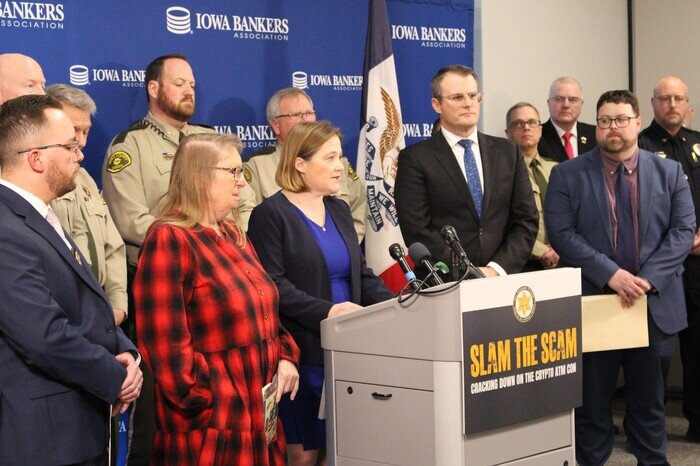
The banking lobby's role in these legislative efforts is not hypothetical. In Iowa, Attorney General Brenna Bird held a press conference to announce her office's crackdown on crypto ATMs — and didn't bother hiding who she teamed up with. The Iowa Bankers Association branding dominated the backdrop, with their step-and-repeat banner prominently positioned behind the AG, law enforcement, and victim advocates. Banks have a direct financial interest in eliminating Bitcoin ATMs: every kiosk that closes is a customer driven back to traditional banking channels for cash management, remittances, and currency conversion. When legislators frame kiosk bans as consumer protection, it is worth asking who benefits most from the "protection."
The Education Imperative
The Minnesota hearing exposed a truth that the Bitcoin ATM industry must confront: legislators do not understand the product, and the industry has not done enough to educate them.
When a committee co-chair can publicly state that she doesn't understand Bitcoin while sponsoring a ban on Bitcoin infrastructure, the industry has failed at stakeholder education. When a legislator can assert that "Bitcoin is the opposite of transparent" without immediate, clear correction from any witness in the room, the industry has failed at public communication.
Education must become a strategic priority — not as a lobbying tactic, but as a genuine public interest obligation. This means:
- Proactive legislative briefings before bills are introduced, not reactive testimony after the hearing is scheduled
- Plain-language explainers on blockchain transparency, KYC processes, and how kiosk compliance compares to other financial products
- Data transparency — voluntarily publishing aggregated transaction data, scam rates, refund rates, and law enforcement cooperation metrics
- Inviting legislators to experience the product — walk them through a kiosk transaction so they see the ID verification, the warnings, the disclosures, the blockchain analytics in real time
- Contextualizing the numbers — every time $333 million is cited, it must be placed alongside the $119 billion true cost of scams, the $16 billion Meta earns from scam ads, and the $46.6 billion in investment fraud losses that flow through entirely different channels
CoinFlip's Lipka has led by example, helping draft Minnesota's 2024 legislation and testifying transparently about CoinFlip's compliance practices, refund policies, and transaction data. The broader industry must match this standard.[17][9][1]
A Proportionate Response
Scams are real. Victims are real. The harm is devastating and demands action. But proportionate action requires understanding what you're regulating, accurately measuring the problem you're solving, and honestly evaluating whether your proposed solution will make things better or worse.
Banning 427 Bitcoin ATMs in Minnesota will not make a meaningful dent in a $119 billion scam economy. It will not stop scammers who use phone calls, social media, gift cards, wire transfers, and online exchanges. It will not educate vulnerable seniors about social engineering tactics. It will not hold Meta accountable for the $16 billion it earns from scam advertising.
What it will do is eliminate a regulated, KYC-compliant financial access point. It will push legitimate users toward dangerous peer-to-peer alternatives. It will remove a valuable law enforcement touchpoint. And it will impose on an industry — and only this industry — a regulatory standard that no other financial product in American history has been asked to meet.
As Lipka put it: "It is inappropriate to ban a legal product because fraud is happening. Not our fault."[1]
The Bitcoin ATM industry isn't perfect. Some operators have failed to implement adequate safeguards — the D.C. Attorney General's lawsuit against Athena Bitcoin, alleging that 93% of its district transactions were fraud-related, demonstrates that bad actors exist within the industry. California's DFPI has rightly cracked down on operators who overcharged consumers and flouted licensing requirements. These enforcement actions are appropriate and necessary.[10][18][19]
But the answer to bad operators is better enforcement and stronger regulation — not the elimination of an entire product category that serves thousands of legitimate customers and provides law enforcement with traceable, documented transaction data that peer-to-peer alternatives never will.
Minnesota's legislators should regulate Bitcoin ATMs like the financial infrastructure they are — with firm standards, aggressive enforcement, and informed oversight. They should not ban what they do not understand.
The Consumer Federation of America's "The Scam Economy" report (March 2026) estimates the true cost of online scams in America at $119 billion annually. Bitcoin ATM fraud, at $333 million in reported losses, represents approximately 0.28% of that figure. Minnesota's estimated true online scam losses are $1.5 billion per year.[11]
Sources & References
- Minnesota House Commerce Finance and Policy Committee hearing on HF 3642, February 26, 2026. Public testimony and committee proceedings. Watch full hearing on YouTube
- Minnesota House File 3642, introduced by Rep. Erin Koegel. Proposes a statewide ban on cryptocurrency kiosks.
- Minnesota Department of Commerce statement of support for HF 3642, Commerce Committee hearing, February 26, 2026.
- FBI Internet Crime Complaint Center (IC3), 2024 Annual Report. Cryptocurrency kiosk-related fraud losses reported at $333 million nationally; adults over 60 accounting for 85%+ of reported losses.
- Victim testimony presented at HF 3642 Commerce Committee hearing, including the Woodbury and St. Cloud cases cited by committee witnesses.
- Rep. Erin Koegel, public statement during HF 3642 committee hearing, February 26, 2026, acknowledging limited understanding of cryptocurrency technology.
- Committee member statement asserting "Bitcoin is the opposite of transparent," HF 3642 hearing, February 26, 2026. CoinFlip General Counsel Larry Lipka's responsive testimony on blockchain transparency.
- Chainalysis, "The 2025 Crypto Crime Report"; Elliptic, "State of Cross-chain Crime." FinCEN and FBI public statements on blockchain analytics in law enforcement investigations.
- Larry Lipka, General Counsel, CoinFlip, testimony before Minnesota Commerce Committee, February 26, 2026. CoinFlip compliance practices including ID verification, blockchain analytics, wallet pinning, and law enforcement cooperation.
- D.C. Attorney General Brian Schwalb, District of Columbia v. Athena Bitcoin, Inc., filed 2025. Complaint alleging 93% of Athena's D.C. transactions were fraud-related.
- Consumer Federation of America, The Scam Economy: The True Cost of Online Scams and Crimes in America, March 2026. Estimates $119 billion in true annual losses using Bureau of Justice Statistics' 14% reporting rate applied to FBI IC3's $16.6 billion in reported 2024 losses. Meta scam advertising figures from Reuters investigation, November 2025. BBB 2024 Scam Tracker platform data.
- Larry Lipka, General Counsel, CoinFlip, opening testimony on regulatory disparity, HF 3642 hearing.
- Larry Lipka testimony on refund mandates for authorized transactions, HF 3642 hearing and prior testimony in Rhode Island legislative proceedings.
- Federal Reserve Regulation E (12 CFR Part 1005), Electronic Fund Transfer Act. Requires financial institutions to refund unauthorized transactions only. No federal requirement exists for refunding voluntarily authorized consumer transactions.
- Minnesota cryptocurrency kiosk consumer protection law, enacted 2024. Requires operators to refund authorized transactions upon consumer request within specified timeframes.
- Rep. Tim O'Driscoll, co-chair, Minnesota Commerce Finance and Policy Committee, statement on bipartisan support for addressing cryptocurrency scams, February 26, 2026.
- Larry Lipka testimony regarding CoinFlip's role in drafting Minnesota's 2024 cryptocurrency kiosk legislation.
- D.C. Office of the Attorney General, "Attorney General Schwalb Sues Crypto ATM Operator for Financially Devastating Scams," press release, 2025.
- California Department of Financial Protection and Innovation, consent order against RockItCoin, 2025. Enforcement action regarding fee disclosures and licensing compliance.