A South Carolina couple filed a seven-count lawsuit against Bitcoin Depot on March 9, 2026, after criminals posing as law enforcement coerced one of the plaintiffs into depositing $14,600 in cash at a Bitcoin ATM — and a Bitcoin Depot representative allegedly told her and a police officer that fraudulent transactions like hers "happen a lot" and that the frequency is "unsettling."
That admission is the most damaging detail in the complaint. It's not a regulator making an inference from data. It's an alleged statement by Bitcoin Depot's own representative, on the record, to a victim standing next to a police officer — less than two hours after the transaction. And the representative still refused to return the money.
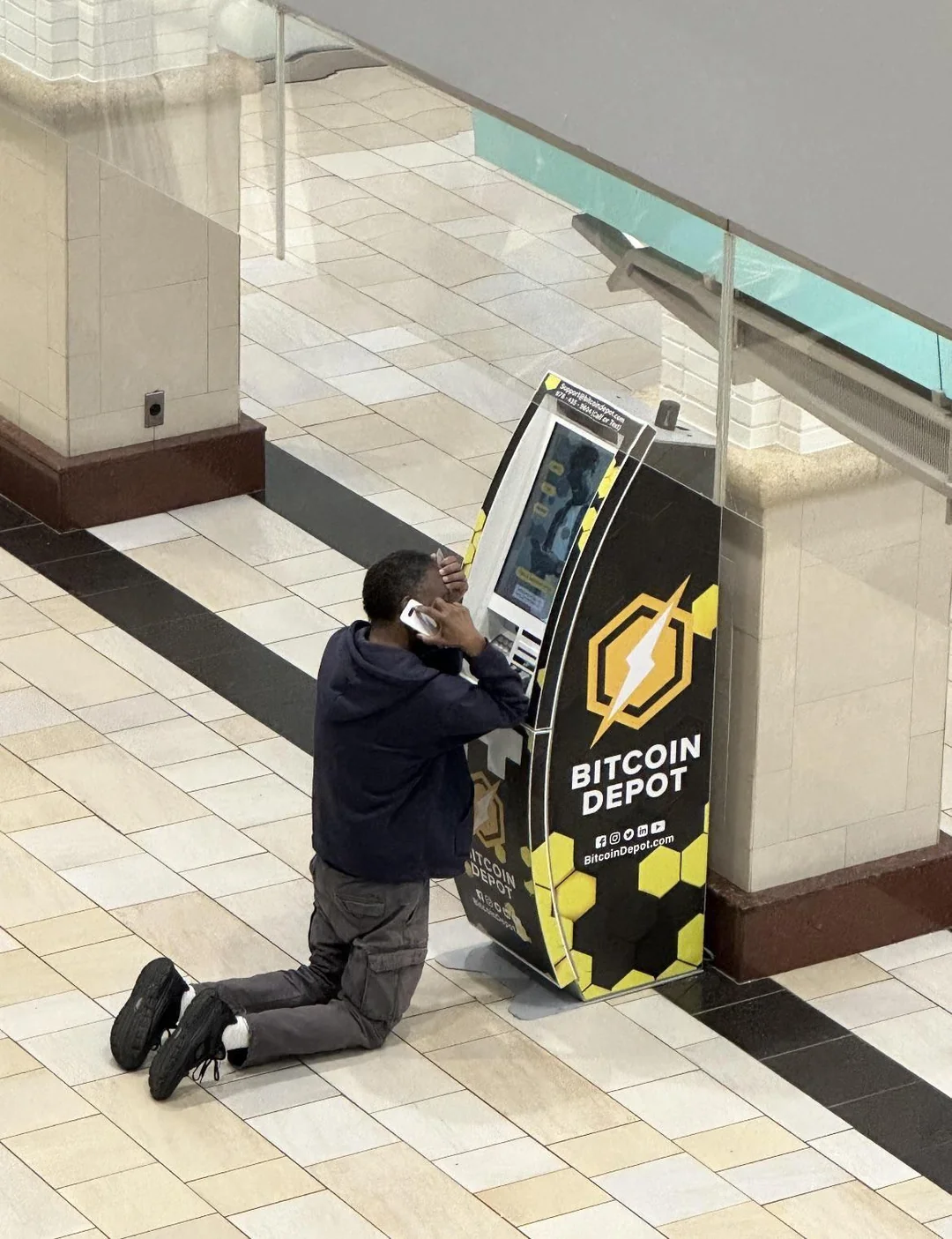
Neutral editorial stock photo of a Bitcoin Depot kiosk in an indoor public concourse. The person pictured is not identified as a victim, customer in the case, or party to the allegations.Image: Bitcoin ATM News editorial assets
Case: Bauer et al. v. Bitcoin Depot Inc.
Court: South Carolina Court of Common Pleas, Ninth Judicial Circuit (Charleston County)
Case No.: 2026CP1001239
Filed: March 9, 2026
Plaintiffs' Counsel: David A. Maxfield, Dave Maxfield Attorney LLC (Columbia, SC)
The complaint lays out a textbook law enforcement impersonation scam — the kind that state attorneys general have alleged constitutes the overwhelming majority of high-value Bitcoin ATM transactions.
At approximately 10:47 a.m., Chandler Furlough Bauer received a call from someone claiming to be a lieutenant with the Charleston County Sheriff's Office. The caller told her she had outstanding warrants for failing to appear for jury duty and would be arrested. He ordered her to stay on the phone, told her that contacting anyone — including her husband — would be a felony, and claimed she was under a "gag order."
Then the threats escalated. The caller said he and others were nearby and watching, and explicitly threatened to kidnap and physically harm her until someone produced $30,000.
Timeline of the December 23 Extortion:
10:47 a.m. — Ms. Bauer receives call from fake "sheriff's lieutenant" claiming warrants for missed jury duty
~11:00 a.m. — Under threats of kidnapping and violence, she withdraws $14,600 cash from Truist Bank ATM
~11:20 a.m. — Directed by caller, she deposits $14,600 into Bitcoin Depot ATM at Citgo gas station on Dorchester Road, North Charleston; $3.00 fee charged; cash converted to Bitcoin and sent to scammer's wallet
~11:20 a.m. — Transaction completes; scammers end the call; Ms. Bauer flees
~11:40 a.m. — Ms. Bauer contacts Mount Pleasant Police Department (~20 minutes post-transaction)
~12:45 p.m. — North Charleston Police officer accompanies Ms. Bauer back to the Bitcoin Depot ATM; they contact a Bitcoin Depot representative and demand return of funds
~12:45 p.m. — Bitcoin Depot representative refuses, says money "already been accounted for"; admits fraud "happens a lot" and frequency is "unsettling"
The complaint alleges Ms. Bauer also filed reports the same day with the FBI's Internet Crime Complaint Center (IC3), Truist Bank, and the FDIC. None of it moved Bitcoin Depot to return the funds.
The Alleged Admission That Changes the Case
The legal significance of the Bitcoin Depot representative's alleged statements cannot be overstated.
"The Bitcoin Depot representative refused to return any funds, stating that the money had 'already been accounted for' and could not be released, and further admitted that fraudulent transactions of this type 'happen a lot' and that it is 'unsettling how frequent' such fraud occurs on Bitcoin Depot's platform."
— Complaint, ¶ 5, Bauer v. Bitcoin Depot Inc.
In the context of existing litigation against Bitcoin Depot, this statement — if proven — would corroborate what attorneys general in Massachusetts, Iowa, and Missouri have alleged: that Bitcoin Depot has long known its machines are disproportionately used for fraud and has continued operating them without adequate safeguards because the transactions are profitable.
The Massachusetts AG lawsuit, filed in February 2026, alleged that 83% of Bitcoin Depot's customers transacting over $10,000 were scam victims, and that scam-related revenue accounted for roughly 60% of Bitcoin Depot's Massachusetts business. The Iowa AG found a 98% scam rate among investigated transactions and $7.2 million in consumer losses.
A company representative telling a victim and a police officer that fraud "happens a lot" is the kind of evidence plaintiffs' attorneys build entire cases around.
Seven Legal Theories — Including a Novel One
The Bauers' complaint brings seven causes of action, ranging from well-trodden consumer protection claims to a creative and aggressive legal theory that could set precedent if it gains traction.
Claims Against Bitcoin Depot
I
Violation of the Electronic Fund Transfer Act (EFTA)
Alleges the coerced transaction was an "unauthorized electronic fund transfer" because it was initiated by criminals through threats of kidnapping — not by the consumer exercising free will. Claims Bitcoin Depot failed to investigate or provide relief after timely notice. Seeks actual damages, statutory damages, attorneys' fees, and punitive damages under 15 U.S.C. § 1693m.
II
South Carolina Unfair Trade Practices Act (SCUTPA)
Alleges Bitcoin Depot's failure to warn consumers, failure to implement fraud safeguards, and refusal to return funds constitute unfair and deceptive practices. Seeks treble damages for willful violations and injunctive relief requiring fraud prevention measures.
III
Unconscionable Transaction
Argues both procedural unconscionability (extreme duress, no meaningful choice) and substantive unconscionability (Bitcoin Depot profiting from extortion proceeds while victim receives nothing). Seeks rescission and restitution.
IV
Negligence / Ultrahazardous Activity
The most novel claim. Alleges Bitcoin Depot's ATM network constitutes an "ultrahazardous and abnormally dangerous activity" due to rapid irreversible cash-to-crypto conversion, attractiveness to criminals, minimal oversight, and the operator's admitted knowledge of frequent fraud. Claims Bitcoin Depot owes a heightened duty of care beyond ordinary negligence.
V
Conversion
Alleges Bitcoin Depot took possession and control of plaintiffs' property, converted it to cryptocurrency, transmitted it to scammers, then refused to return it despite notice from law enforcement — constituting wrongful exercise of dominion over their funds.
VI
Unjust Enrichment
Pleaded as an alternative to conversion. Alleges Bitcoin Depot received and retained $14,603 from a fraud victim and has no legitimate justification for keeping it.
VII
Violations of South Carolina Uniform Money Services Act
Alleges Bitcoin Depot failed to implement required security and anti-fraud measures, failed to act in good faith, and failed to provide meaningful error-resolution procedures as required for money services businesses operating in South Carolina.
The "Ultrahazardous Activity" Theory
The fourth count is the one to watch. The complaint argues that Bitcoin Depot's ATM network should be treated as an "ultrahazardous and abnormally dangerous activity" — a legal doctrine traditionally reserved for things like blasting operations, storing explosives, or keeping wild animals.
The theory: because Bitcoin ATMs enable rapid, largely irreversible conversion of large cash amounts into cryptocurrency with minimal oversight, and because the operator itself admits criminals exploit them frequently, the machines create the kind of extraordinary risk that imposes strict or heightened liability on the operator — regardless of whether the operator was "negligent" in a traditional sense.
It's an aggressive argument. Courts have historically been reluctant to expand the ultrahazardous activity doctrine to new categories. But the complaint makes a focused case: the combination of irreversibility, anonymity, speed, and the operator's own admission of frequent criminal exploitation creates a risk profile unlike ordinary financial services.
If a South Carolina court accepts even a modified version of this theory, it could have significant implications for how Bitcoin ATM operators are legally categorized nationwide.
Bitcoin Depot's Growing Legal Exposure
The Bauer lawsuit lands on a company already buried in enforcement actions.
F (0)
Bitcoin Depot Trust Score
4
Pending Regulatory Actions
3+
Pending Litigations (Now Including Bauer)
1.3/5
Trustpilot Score (64 Reviews)
Bitcoin Depot (NASDAQ: BTM) currently faces:
- A **Massachusetts AG lawsuit** (February 2026) alleging 83% of high-value customers were scam victims, $10.6 million in scam revenue, drip pricing, and securities fraud for allegedly hiding a 90% scam rate from investors
- An **Iowa AG lawsuit** (February 2025) alleging a 98% scam rate among investigated transactions, $7.2 million in consumer losses, and hidden 23% fees
- A **Missouri AG Civil Investigative Demand** (January 2026) as part of an industry-wide investigation
- **Minnesota Department of Commerce charges** for alleged money transmission violations
- An **$18.47 million CAD arbitration award** in an unrelated contract dispute with Cash Cloud LLC
- **Ontario litigation** from BitAccess co-founder Moe Adham
The Bauer case adds South Carolina to the list — and unlike the AG actions, it's a private plaintiff bringing a jury trial demand with a punitive damages claim. The treble damages available under SCUTPA and the statutory damages under EFTA mean potential exposure well beyond the $14,603 at stake.
What This Means for Bitcoin ATM Scam Victims
If you've been scammed at a Bitcoin ATM, here's what the Bauer case tells you:
Report immediately. The Bauers had law enforcement at the ATM within 90 minutes. That speed of reporting strengthens every legal claim. Call police, file an IC3 report, and notify the operator in writing.
Document the operator's response. The alleged "happens a lot" statement is central to this case. If an operator representative says anything about the frequency of fraud, write it down immediately — with the date, time, and any witnesses.
"Already been accounted for" is not a legal defense. This complaint challenges the idea that crypto transactions are inherently final and unrecoverable. Operators have compliance obligations regardless of blockchain mechanics.
You may have more legal options than you think. This complaint brings seven separate causes of action — federal, state consumer protection, common law, and money services regulations. Consult a consumer protection attorney in your state.
The Bauer complaint raises stakes for every Bitcoin ATM operator in ways that go beyond the dollar amount.
**The "ultrahazardous activity" theory is a warning shot.** If any court accepts this characterization — even in dicta — it could transform the liability framework for the entire industry. Operators who currently defend themselves by pointing to Terms of Service agreements and the "decentralized" nature of crypto would face a strict liability standard instead. The complaint is explicitly designed to test this theory.
**Employee and representative statements matter.** Whatever Bitcoin Depot's official policy may be, the alleged statement by a representative that fraud "happens a lot" and is "unsettling" in frequency may be treated as an admission by the company. Every operator should review what their customer service representatives, call center agents, and on-site contacts are authorized to say — and what they're actually saying.
**Speed of fraud reporting creates legal obligations.** When a victim and a police officer show up at your machine 90 minutes after a transaction and tell you it was extortion, "already been accounted for" is not a compliance response. Operators need documented rapid-response protocols that include escalation, investigation, and — where feasible — cooperation with law enforcement on fund recovery.
**South Carolina is now on the map.** The complaint invokes both the SC Unfair Trade Practices Act (treble damages) and the SC Uniform Money Services Act. Operators with machines in South Carolina should review their compliance with state-specific money services requirements, particularly error-resolution and anti-fraud obligations.
The Bauers have demanded a jury trial. For a case involving a woman threatened with kidnapping on the phone while feeding cash into a machine at a gas station — where the operator allegedly acknowledged fraud is routine and still kept the money — that's exactly the kind of fact pattern a plaintiff's attorney wants in front of twelve people.
Bitcoin Depot has not yet filed a response. The company has 30 days from service to answer the complaint. Watch for whether Bitcoin Depot moves to dismiss any of the seven counts — particularly the EFTA and ultrahazardous activity claims, which present the most novel legal questions — or whether this case heads toward discovery, where the contents of Bitcoin Depot's internal fraud data and employee communications could become public record.