

A 73-year-old recently widowed woman in South Carolina fed 150 hundred-dollar bills — one at a time — into a Bitcoin Depot kiosk while scammers coached her over the phone. She lost $15,000. On top of it, Bitcoin Depot Inc. (NASDAQ: BTM) — the largest Bitcoin ATM operator in North America — collected approximately $7,700 in markup fees from the transaction. When she filed suit (Mooneyham v. Bitcoin Depot, Case No. 3:24-cv-01774-SAL), the company moved to compel arbitration based on terms she had accepted on the kiosk touchscreen moments before losing her savings.
She was far from alone. According to the Massachusetts Attorney General's complaint, Bitcoin Depot's own due diligence team concluded in 2021 that 90% of its largest customers were scam victims. The company's response, the AG alleges, was not to strengthen protections but to weaken them — reducing screening questions and raising daily transaction limits from $15,000 to $25,000. Through it all, founder and CEO Brandon Mintz extracted more than $90 million through stock sales, corporate distributions, and structural payments while the stock collapsed over 93% from its SPAC listing price.
Now four state attorneys general have filed suits or investigations. The Massachusetts AG has taken the extraordinary step of alleging that Bitcoin Depot willfully deceived its own investors, seeking a court order allowing stock purchasers to tender their shares for a full refund — a remedy that, if granted, would be unprecedented for a publicly traded crypto company. And every single person who occupied a position of corporate oversight during the period of alleged fraud facilitation has departed — the Audit Chair, the auditor, the CFO, the Chief Compliance Officer, and the CEO — while Mintz retains 90.4% of voting power.

Count V — The Investor Deception Charge: The Massachusetts Attorney General's complaint includes a legally unprecedented claim: that Bitcoin Depot willfully withheld material information from investors, framing active fraud facilitation as a hypothetical “risk factor” in SEC filings. The AG is seeking a court order requiring the company to offer shareholders a full refund on their stock purchases. Read the full analysis ↓
- $90M+ extracted by CEO Brandon Mintz through distributions, stock sales, and structural payments while the stock collapsed 93%
- 90% of large customers were scam victims according to Bitcoin Depot's own 2021 due diligence team
- Four state AGs (MA, IA, ME, MO) have filed suits or investigations alleging the company knowingly profited from fraud
- Every oversight officer from the SPAC era has departed — Audit Chair, auditor, CFO, CCO, and CEO
- 90.4% voting control retained by Mintz through super-voting shares, exempting the company from normal governance requirements
- $18.5M arbitration loss disclosed only after a $15M equity offering, raising questions about the timing of material disclosures
How we reported this: This investigation is based on a review of more than 40 SEC filings (Forms 4, 8-K, 10-K, 10-Q, DEF 14A, CORRESP), civil complaints from four state attorneys general (Massachusetts, Iowa, Maine, Missouri), Canadian Arbitration Association proceedings, the ICIJ/CNN “Coin Laundry” investigation, corporate earnings transcripts, and contemporaneous news reports. All stock prices and financial figures are sourced from EDGAR filings and public market data. Bitcoin Depot was contacted regarding the allegations described in this article; the company’s public statements are noted where applicable. All allegations are claims made in legal proceedings and have not been adjudicated.
On March 31, 2026, Bitcoin Depot filed an S-1 registration statement with the SEC that disclosed additional self-dealing arrangements, an updated insider extraction tally exceeding $90 million, and significant governance issues — including a Compensation Committee that founder Brandon Mintz chaired while approving his own 120% pay raise, a related-party kiosk deal with Mintz’s personal company that has produced $0 in net revenue for shareholders, and 90.4% voting control retained after every officer resignation. We have moved the full analysis of those disclosures into a standalone deep dive: Bitcoin Depot’s S-1 Reveals a Self-Dealing Architecture →
The Money Machine: How Mintz Extracted Over $90 Million
Brandon Mintz founded Bitcoin Depot in 2016 and took it public through a SPAC merger with GSR II Meteora Acquisition Corp. on June 30, 2023. The SPAC had raised $275 million at the standard $10.00 per share IPO price. What followed was a masterclass in insider cash extraction through multiple channels, executed even as the company's stock cratered and lawsuits mounted.
The Up-C Structure: A Cash Pipeline to Mintz
Bitcoin Depot went public using an Up-C corporate structure — a complex arrangement that allowed Mintz, through his entity BT Assets Inc., to retain ownership of 41,193,024 shares of Class V common stock (later converted to Class M shares). This structure enabled distributions to flow directly to Mintz as the sole member of BT Assets, outside the view of most retail investors. According to SEC filings, approximately $36.7 million in distributions flowed through this structure to BT HoldCo members — primarily Mintz — during 2024 alone, per the S-1’s Related Party Transactions disclosure (three-year total 2023–2025: $61.8 million).
The foundational agreements dictated that these tax distributions be calculated based on the highest possible assumed tax rates, frequently resulting in cash payouts that vastly exceeded any actual tax obligations. The 10-K filings explicitly acknowledged this friction, warning public investors that Mintz's financial interests regarding the timing and magnitude of distributions might directly conflict with the best interests of the company and its broader shareholder base.
When the company finally unwound the Up-C structure on May 30, 2025, it paid BT Assets (Mintz's entity) a total of $9.3 million in cash payments to terminate the Tax Receivable Agreement (TRA) — an instrument that had legally obligated the public company to pay BT Assets 85% of any future cash savings from certain tax attributes. The restructuring also gave Mintz 41,193,024 Class M shares carrying 10 votes per share, ensuring his continued control of the company even as his economic extraction continued.
Direct Stock Sales: Selling Into the Storm
SEC Form 4 filings paint a relentless picture of insider selling. Mintz made at least 18 sale transactions over a roughly two-year period, steadily liquidating stock while the company faced mounting legal exposure.
| Date | Shares Sold | Avg. Price | Total Proceeds | Concurrent Events |
|---|---|---|---|---|
| Apr 24, 2024 | 2,906,976 | $1.72 | $4,999,999 | IA AG investigating |
| Sep 5–9, 2025 | 330,963 | ~$3.55 | $1,190,000 | Omitted 10b5-1 plan |
| Sep 18–22, 2025 | 225,930 | ~$3.76 | $849,863 | Post-disclosure |
| Oct 6–8, 2025 | 1,740,524 | ~$3.43 | $6,416,393 | $15M raise at $3.50 |
| Nov 3–5, 2025 | 349,736 | ~$2.61 | $913,702 | Pre-arbitration loss |
These represent only Mintz's direct stock sales. Combined with the Up-C distributions and TRA termination payment, the total cash extraction by Mintz and his entities from Bitcoin Depot exceeds $90 million — a figure extracted from a company that reported negative stockholders' equity of -$16.5 million at the end of 2024 and was forced to execute a 1-for-7 reverse stock split in February 2026 to avoid Nasdaq delisting.
Company response: Bitcoin Depot has characterized the Up-C distributions as standard tax distributions required under its operating agreement, and the 10b5-1 stock sales as pre-planned transactions executed under SEC-compliant trading plans. The company has not publicly addressed the aggregate extraction figure.
The 8 Million Share Selling Plan
Perhaps most striking was the revelation, disclosed in a September 2, 2025 SEC filing, that Bitcoin Depot had “inadvertently” omitted required disclosures about executive trading plans from its 10-Q for the quarter ending June 30, 2025. The belated disclosure revealed that Mintz and his entities had adopted a Rule 10b5-1 trading plan on May 31, 2025, authorizing the sale of up to 8 million shares of Class A common stock — a plan that would feed continuous selling through May 2026. COO Scott Buchanan (later appointed CEO January 1, 2026; resigned March 23, 2026 after 82 days) also had a separate plan for 125,000 shares.
The “inadvertent” omission meant that investors were unaware of the CEO's massive planned selling program during the very quarter it was adopted. The subsequent selling spree — totaling nearly $10 million from September through November 2025 — was executed under this plan while the company simultaneously conducted a $15 million registered direct offering at $3.50 per share in October 2025. Mintz was selling into the very offering meant to raise capital for the company.
Forbes 30 Under 30: Celebrated While Consumers Were Defrauded
On December 4, 2023, Forbes announced that Brandon Mintz had been named to its prestigious 30 Under 30 list in finance for the Class of 2024. The selection came just five months after Bitcoin Depot's SPAC listing — and roughly two years after the company's own due diligence team had, according to the Massachusetts Attorney General's complaint, concluded that 90% of its largest customers were scam victims.
Bitcoin Depot treated the honor as a major marketing milestone, issuing a full press release and creating a dedicated landing page on its website. The Forbes recognition lent Mintz and his company a veneer of legitimacy at the precise moment when, according to state attorneys general, the company's machines were facilitating fraud on a massive scale. The Iowa Attorney General had already launched its investigation into Bitcoin ATM operators two months earlier, in October 2023.
Mintz now joins an increasingly notorious roster of Forbes 30 Under 30 alumni who went on to face fraud allegations or criminal charges. Sam Bankman-Fried, the founder of FTX, was named to the Class of 2021 before his conviction on fraud and conspiracy charges. Caroline Ellison, the former Alameda Research CEO who cooperated in that case, was in the Class of 2022. Charlie Javice, founder of Frank, was charged with defrauding JPMorgan out of $175 million after making the 2019 list. Martin Shkreli, named in the Class of 2013, was later convicted of securities fraud. The pattern has become so well-known that the honor itself has been described as a “pipeline to prison.”
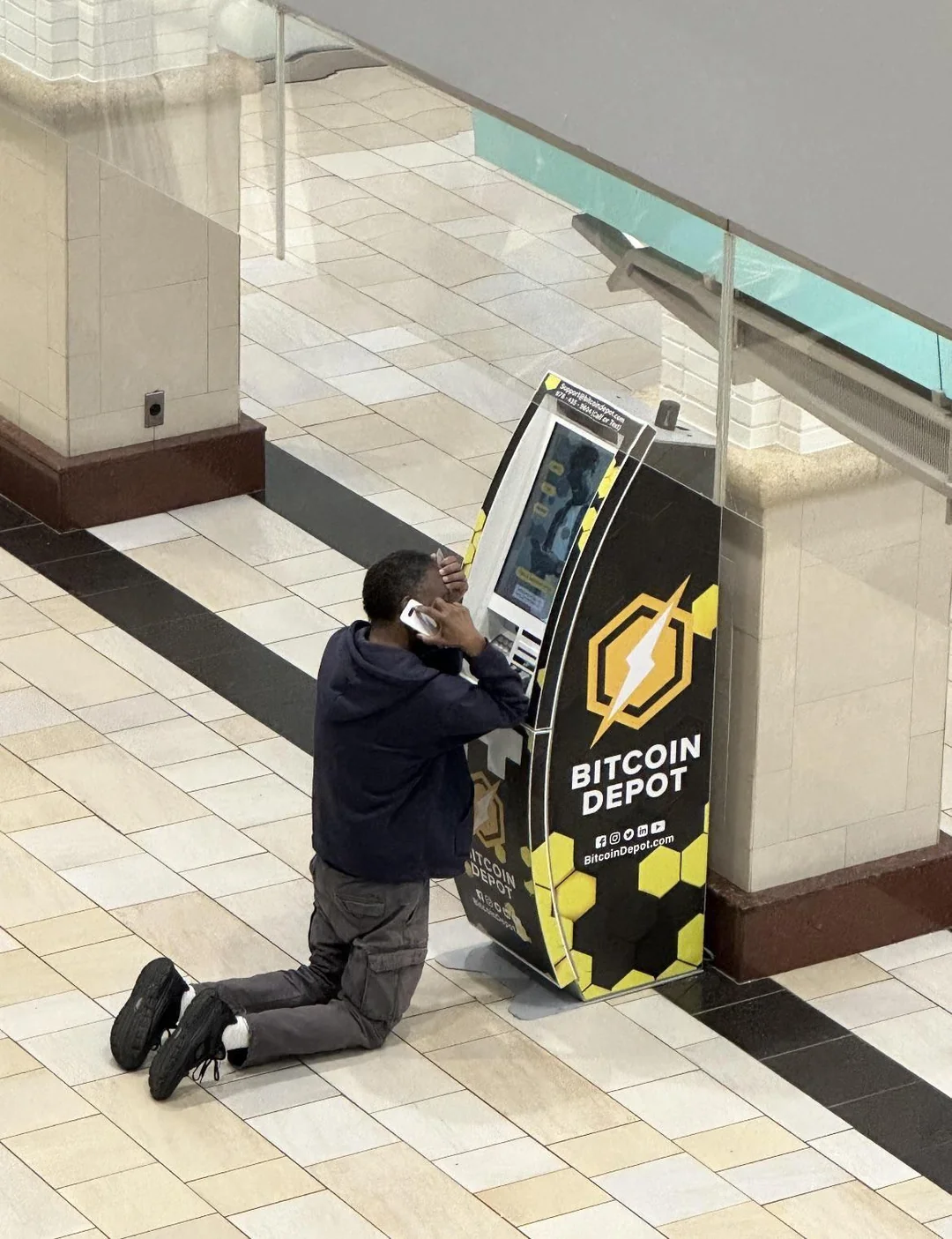
More than $90 million flowed out to Mintz and his affiliated entities. The company simultaneously took on over $70 million in toxic debt to keep the kiosks running.
The Revenue Engine: Drip Pricing, Hidden Markups, and Systemic Fraud
Drip Pricing: The Hidden Fee Machine
The Massachusetts Attorney General's complaint details a deceptive “drip pricing” scheme at the heart of Bitcoin Depot's revenue model. When a consumer approaches a kiosk, they are presented with an initial flat fee — typically three dollars — alongside an advertised price of Bitcoin that closely mirrors standard market exchange rates. However, as the transaction progresses and the user commits physical cash to the machine, the company allegedly introduces severe, undisclosed markups on the cryptocurrency's actual price.
According to the civil complaint, Bitcoin Depot routinely applied an algorithmic markup ranging between 15% and 50% on the spot price of the cryptocurrency. By the end of 2024, the standard markup had allegedly increased to more than 40%. For context, conventional online cryptocurrency exchanges typically charge execution fees ranging from a fraction of a percent to 3%. The AG alleges this drip pricing structure ensured that consumers — many of whom were financially unsophisticated or operating under extreme emotional duress induced by scammers — completed transactions without realizing that up to a third of their deposited cash had been consumed by the operator's spread.
In thousands of documented transactions, the company allegedly violated its own stated terms of service by charging spreads far in excess of its publicly claimed maximum of 23%.
What the Company Knew, and When
The Massachusetts Attorney General's complaint, filed February 3, 2026, contains perhaps the most damning allegation: that Bitcoin Depot's own due diligence team concluded in 2021 that 90% of customers the team interacted with were scam victims. According to the same complaint, one employee warned a top company executive that the kiosks were facilitating money laundering at an “extreme volume.”
In Iowa, 98% of the money Iowans reported sending through Bitcoin Depot kiosks was tied to scams. The company collected a 23% commission on every dollar. — Iowa Attorney General Petition, Feb 2025
Rather than strengthening protections, the Massachusetts AG alleges, the company's strategic response exacerbated the harm. Management reportedly removed critical anti-fraud safeguards, reduced the number of screening questions asked at the point of sale, and intentionally raised daily transaction limits from $15,000 to $25,000 — changes that streamlined the extraction process for fraudsters and maximized the exorbitant spread revenue captured by the company.
According to the Massachusetts complaint, the company's own internal metrics showed that between 13% and 16% of funds processed through the machines from March to September 2023 were scam-related. But the AG's own analysis found the reality was far worse: over half of all money passing through Bitcoin Depot kiosks in Massachusetts between August 2023 and January 2025 was scam-related. Among customers who spent $10,000 or more, the AG alleges more than 80% were scam victims, with fewer than 10 legitimate high-value customers identified. During this period, the complaint alleges, nearly 60% of the company's entire gross revenue in Massachusetts was derived directly from scam-related transactions.
Prosecutors also allege the company approved transactions with obvious red flags, including customers using aliases like “John Wick” and “The Chosen One,” and sending funds to cryptocurrency exchanges inaccessible to U.S. consumers. When victims realized they had been defrauded and contacted the company to halt transactions, the AG alleges Bitcoin Depot routinely adopted a policy of willful inaction — informing victims that nothing could be done while simultaneously refusing to refund the substantial fee spreads the company had already withheld.
Company response: Bitcoin Depot has stated it is “committed to compliance and consumer protection” and has pointed to recent measures including universal ID verification at all kiosks, “additional protections for seniors,” and cooperation with law enforcement. The company has not publicly responded to the specific allegation that its own team found 90% of large customers were scam victims.
The Victims
The human cost is staggering. In Iowa, the attorney general found that more than $20 million was lost by Iowans through Bitcoin Depot and CoinFlip ATMs combined between October 2021 and July 2024. Of that total, the Iowa AG's filing specifically identifies more than $7 million in fraudulent, scam payments processed through Bitcoin Depot alone. The majority of victims were over 60. The Iowa investigation found that 98% of the money Iowans reported sending through Bitcoin Depot kiosks was tied to scam transactions. Bitcoin Depot collected an average 23% commission on each one.
The cases are devastating in their particulars. The 73-year-old South Carolina widow described in the opening of this investigation — who fed 150 hundred-dollar bills into a Bitcoin Depot kiosk while scammers coached her on the phone — was one of hundreds. When she sued, the company moved to compel arbitration based on terms she accepted on the kiosk touchscreen. In Iowa, a 69-year-old man who had recently suffered a stroke deposited $15,000 at a Bitcoin Depot machine in a liquor store; when the sheriff seized the cash, Bitcoin Depot fought for it all the way to the Iowa Supreme Court — and won. The victim never got his money back.
“I have spoken to people in their 80s who are preparing to file bankruptcy for the first time … young adults who thought they were helping their family and emptied out the family's common bank account. When you are the bearer of the bad news, that everything they have worked for their entire lives, their entire life was gone in the blink of an eye, I mean, there are no good words.”
— Alona Katz, Chief, Brooklyn DA's Virtual Currency Unit
State Enforcement Actions: A Growing Avalanche
Active Enforcement Against Bitcoin Depot:
- Massachusetts (February 2026): AG Andrea Joy Campbell filed suit alleging the company knowingly facilitated scams costing consumers more than $10 million, while removing fraud safeguards and misleading investors about the extent of scam-derived revenue. The complaint includes an extraordinary Count V, discussed in detail below.
- Iowa (February 2025): AG Brenna Bird sued Bitcoin Depot and CoinFlip alleging $20+ million in combined consumer losses across both operators, with more than $7 million attributable to Bitcoin Depot alone. The AG concluded more than 50% of Bitcoin Depot's Iowa transactions were scam-related between October 2021 and July 2024, with Bitcoin Depot taking a 23% cut of every scam dollar.
- Maine (2025): $1.9M settlement; all 80 kiosks removed from the state after regulators denied its license application, finding the ATMs “caused an unacceptably high number of Maine consumers to suffer financial loss.” Elderly consumers accounted for more than 70% of money transmitted on its machines in the state.
- Missouri (December 2025): AG Catherine Hanaway issued Civil Investigative Demands to Bitcoin Depot and four other operators, investigating hidden fees and deceptive practices.
- Washington, D.C.: Prosecutors have drawn similar conclusions about scam activity on machines in their jurisdiction operated by Athena Bitcoin, the industry's third-largest operator.
| State | Date Filed | Key Allegations | Amounts | Status |
|---|---|---|---|---|
| Massachusetts | Feb 3, 2026 | Knowingly facilitating scams, drip pricing, investor deception (Count V), removing fraud safeguards | $10M+ consumer losses | Pending |
| Iowa | Feb 2025 | $20M+ combined losses (with CoinFlip); 50%+ scam transaction rate; 23% commission on scam proceeds | $7M+ (BTM alone) | Pending |
| Maine | 2025 | Unlicensed money transmission; “unacceptably high” consumer losses; 70%+ of volume from elderly | $1.9M settlement | Settled; 80 kiosks removed |
| Missouri | Dec 2025 | Civil Investigative Demands re: hidden fees and deceptive practices | TBD | Investigation |
| Federal (N.D. Ga.) | Jul 2025 | Class action: data breach (26,732 customers), negligence, invasion of privacy | TBD | Pending |
Count V: The Investor Deception Charge
The most legally perilous dimension of the Massachusetts complaint is Count V, which alleges that Bitcoin Depot willfully withheld material information from investors in violation of state law. The AG's theory is straightforward and devastating: in its SEC Form 10-K filings, Bitcoin Depot's management carefully crafted risk factors that framed fraudulent use of its kiosks as a hypothetical, forward-looking “risk” that might potentially impact the business. The AG argues this disclosure was materially false and misleading by omission — management possessed concrete internal metrics proving that fraud was not a future risk, but rather the current, active, and primary driver of the company's transactional volume and gross profit.
The remedy the AG is seeking is extraordinary: a court order requiring Bitcoin Depot to offer Massachusetts purchasers of its securities the option to tender their shares for a full refund or receive compensatory damages. If granted, this would represent a massive financial liability and an unprecedented regulatory outcome for a publicly traded crypto company.
Separately, securities litigation firm Wolf Popper LLP announced investigations into Bitcoin Depot in 2024, highlighting the disconnect between the company's optimistic public narrative and its market performance. By April 2024, Wolf Popper noted that Bitcoin Depot's stock had already fallen approximately 82.9% from the $10 SPAC listing price to about $1.71 per share — long before the BitAccess arbitration loss, the Massachusetts complaint, and the full extent of insider cash-outs were publicly known.
Company response: Bitcoin Depot’s SEC filings include risk-factor disclosures stating that its kiosks “may be used in connection with fraudulent or illegal transactions” and that “negative developments or perceptions” regarding such use “could adversely affect” the business. The company has not publicly responded to the Massachusetts AG’s specific allegation that these disclosures were materially misleading by framing an active, known problem as a hypothetical future risk.
The ICIJ “Coin Laundry” Investigation
The International Consortium of Investigative Journalists published its landmark “Coin Laundry” investigation in November 2025, exposing how cryptocurrency companies profit from the proceeds of crime. Bitcoin Depot featured prominently in the findings.
The ICIJ and CNN investigation documented how Bitcoin Depot machines installed in hundreds of Circle K convenience stores had facilitated at least $1.5 million in scam transactions. Circle K received millions in rental fees from the partnership while Bitcoin Depot kept between 15% and 50% of each deposit. A former Bitcoin Depot employee told the ICIJ that eliminating scams entirely would hurt the business, stating: “If we were to eliminate scams 100%, we would be hurting.”
The investigation also documented the case of Iowa grocery chain Fareway, which signed a deal with Bitcoin Depot to install 66 machines in April 2024. By February 2025, Fareway had unplugged them all, alleging the machines had become “instrumentalities of massive fraud.” Bitcoin Depot did not publicly address the fraud allegations. Instead, it sued Fareway for breach of contract, demanding the retailer turn the machines back on and pay damages for lost business. The case settled in November 2025.
Company response: Bitcoin Depot has not publicly commented on the ICIJ investigation's findings. The Fareway lawsuit was settled in November 2025; terms were not disclosed.
Corporate Governance Breakdown: An Exodus of Oversight
The corporate governance failures at Bitcoin Depot extend far beyond any single event. Examined chronologically, the departures of key oversight personnel form a systematic pattern: every individual who was in a position to provide independent oversight during the period of alleged fraud facilitation has now left the building — while the man who controlled the company then still controls it now.
The Audit Committee: Completely Gutted
The Audit Committee — the board body charged with overseeing financial reporting, internal controls, and the external audit relationship — was systematically dismantled over the course of 2024 and 2025.
Jackie Marks, the original Audit Committee Chair, was a seasoned CFO with experience at AllianceBernstein and Condé Nast. She resigned in July 2024 — just months before KPMG was dismissed as auditor and material weaknesses in internal controls were formally identified. Her replacement was a healthcare executive with zero cryptocurrency or fintech experience.
Tim Vanderham, an original Audit Committee member, announced his resignation in December 2024. His seat was left vacant until August 2025 — meaning the Audit Committee was potentially understaffed for eight months during active state attorney general investigations and while material weaknesses remained un-remediated.
By mid-2025, zero of the three original Audit Committee members from the SPAC closing remained. The entire oversight body that was supposed to safeguard the integrity of the company's financial reporting had turned over completely — replaced during the most turbulent period in the company's history.
The Full C-Suite Purge
The Audit Committee departures were part of a broader exodus of every senior officer and director who held oversight responsibility during the period of alleged fraud:
| Departure | Role | Date | Significance |
|---|---|---|---|
| Jackie Marks | Audit Committee Chair | July 2024 | Months before KPMG dismissal and material weakness disclosure |
| KPMG LLP | External Auditor | August 2024 | Big Four firm replaced by regional Wolf & Company |
| Glen Leibowitz | CFO | November 2024 | Resigned “for personal reasons”; no permanent replacement named |
| Tim Vanderham | Audit Committee member | December 2024 | Seat vacant 8 months during AG investigations |
| Mark Smalley | Chief Compliance Officer | June 19, 2025 | Departed days before Iowa AG lawsuit; received “extreme volume” warning |
| [Vacant] | CCO Position | June–July 2025 | No Chief Compliance Officer for a full month |
| Brandon Mintz | CEO | December 2025 | Stepped down to Executive Chairman; retains 90.4% voting power |
| Elizabeth Simer | COO | March 11, 2026 | Resigned |
| Scott Buchanan | CEO | March 23, 2026 | Resigned after 82 days as CEO |
| Brandon Mintz | Executive Chairman | March 23, 2026 | Resigned; retained board seat + 90.4% voting power as “advisor to CEO” |
| Alex Holmes | CEO / Chairman | March 23, 2026 | Third CEO in 82 days; former CEO of MoneyGram International; $4.7M+ comp package |
The sequence is striking: Audit Chair gone → Auditor fired → CFO resigned → Second Audit Committee member gone → CCO departed (days before the Iowa AG lawsuit) → No CCO for a full month → CEO stepped down. Mark Smalley, the CCO who had received the “extreme volume” warning about money laundering activity, departed on June 19, 2025 — just days before the Iowa Attorney General filed suit.
The “Controlled Company”: 90.4% Voting Power
The final piece of the governance puzzle is perhaps the most consequential. According to Bitcoin Depot's proxy filings, Brandon Mintz retains 90.4% of the company's total voting power through his Class M shares, which carry 10 votes per share. This concentration of control means the company qualifies as a “controlled company” under Nasdaq listing rules — exempting it from requirements that a majority of the board be independent, that compensation and nomination committees be fully independent, and other standard governance safeguards.
The CEO transition to Scott Buchanan in January 2026 is, in this context, purely cosmetic. Mintz moved to the Executive Chairman role (a title he subsequently resigned on March 23, 2026, while retaining his board seat and 90.4% voting power as “advisor to the CEO”) — a position from which he retains strategic authority over the company. With 90.4% voting power, no board action, executive appointment, or strategic decision can proceed without his approval. The public shareholders, collectively, have negligible influence over corporate governance.
This structural reality means that even as every oversight figure from the SPAC era has departed, the individual who controlled the company during the period of alleged fraud — and who extracted more than $90 million from it — retains absolute control. There is no mechanism through which public shareholders can effect meaningful governance reform, replace board members, or hold management accountable through the normal proxy process.
Company response: Bitcoin Depot characterized the CEO transition as part of a planned leadership evolution. The company has not addressed questions about the timing of oversight departures relative to enforcement actions, or about the concentration of voting power under the “controlled company” exemption.
With 90.4% voting power, no board action, executive appointment, or strategic decision can proceed without his approval. The public shareholders have negligible influence. — SEC DEF 14A Proxy Statement
A Contentious Birth: The $22.3 Million SPAC Fee Dispute
Bitcoin Depot's troubles began before it even completed its SPAC listing. On January 13, 2023, Canaccord Genuity, the Canadian investment bank that had served as a financial advisor on the transaction, filed a lawsuit in the Superior Court of Justice in Toronto seeking $22.3 million in damages. Canaccord alleged that Bitcoin Depot's pre-SPAC entity, Lux Vending LLC, terminated the advisory engagement to avoid paying fees. The company disclosed in its SEC filing that it denied the allegations and intended to vigorously defend against the claims.
The Auditor Departure and Material Weaknesses
In August 2024, Bitcoin Depot abruptly dismissed KPMG LLP — a Big Four accounting firm — and replaced it with Wolf & Company, P.C., a smaller regional firm. The transition occurred under a dark cloud: management and auditors had identified multiple material weaknesses in internal control over financial reporting.
The specific deficiencies were damning for a cash-intensive business. The company lacked the technical accounting resources required to properly analyze complex transactions, failed to maintain formalized risk assessment systems, and — most alarmingly for an enterprise entirely dependent on physical currency — exhibited ineffective reconciliation controls over “cash in transit.” The inability to properly reconcile the millions of dollars in physical cash sitting in thousands of remote kiosks and moving via armored trucks represented a catastrophic failure of basic operational hygiene.
Even after the auditor transition, management was forced to admit in subsequent quarterly filings throughout 2025 that several of these material weaknesses remained entirely un-remediated, rendering the company's disclosure controls fundamentally ineffective.
The Data Breach and 13-Month Delay
On June 23, 2024, Bitcoin Depot detected unauthorized access to its network. The breach compromised personal information of 26,732 customers, including names, phone numbers, driver's license numbers, addresses, dates of birth, and email addresses — precisely the KYC data the company was required to collect under federal anti-money laundering regulations.
Customers were not notified until July 2025 — more than a year later. The company cited a federal law enforcement investigation as the reason for the delay. A class action lawsuit was subsequently filed in the Northern District of Georgia alleging negligence, invasion of privacy, and breach of implied contract. Notably, Bitcoin Depot's SEC filings during the period between the breach (June 2024) and disclosure (July 2025) did not appear to disclose the incident as a material event — even as insiders continued selling stock throughout this period.
The BitAccess Arbitration: $18.5 Million in CEO-Directed Damages
On November 24, 2025, Bitcoin Depot disclosed via 8-K that the Canadian Arbitration Association had awarded Cash Cloud (the successor entity to Coin Cloud) $18.47 million in damages against BitAccess, a subsidiary Bitcoin Depot acquired in 2021.
The backstory makes the judgment far more damning than a routine commercial dispute. BitAccess had been engaged in a master software agreement with Cash Cloud, which at the time managed thousands of competing Bitcoin ATMs. In 2022, after Bitcoin Depot took operational control of BitAccess, Cash Cloud alleges the subsidiary improperly severed its access to the terminal software — effectively disabling the competitor's network. A federal judge in the parallel US adversary proceeding (Case 23-1015) ordered Mintz to sit for a deposition in October 2025, rejecting his “apex deponent” defense after finding he was directly involved in August–September 2022 email exchanges concerning the software deactivation. Cash Cloud has cited the shutdown as a contributing factor in its subsequent Chapter 11 bankruptcy filing in early 2023.
Court exhibits filed in the adversary proceeding reveal the content of at least one of those emails. On August 30, 2022 — the day before Cash Cloud reported the undertaking breach to the Ontario court — Mintz emailed BitAccess executives Andrew McDonald and Moe Adham, with Bitcoin Depot’s Scott Buchanan copied: “This is confirmation that I have advised you to turn off all of Coin Clouds kiosks immediately and that I am comfortable with the risks” (Doc 134, Exhibit 3). The email removes any ambiguity about who directed the shutdown of a competitor’s network while a Canadian court undertaking prohibited exactly that action.
The timing of the disclosure raises additional questions. Arbitration hearings occurred in December 2024 and March, April, and October 2025. The $18.47 million judgment was not disclosed until a Form 8-K filed on November 24, 2025 — critically, after the company had already completed its $15 million equity offering in October. Investors who purchased equity during that offering have a compelling argument that the registration statement and prospectus omitted a material pending legal proceeding and loss contingency.
Post-Bankruptcy Host Solicitation: The False Statements Bitcoin Depot Did Not Deny
The parallel US adversary proceeding (Case 23-01015-MKN, Nevada Bankruptcy Court) reveals conduct that goes beyond the software dispute. According to Cash Cloud's Reply in Support of its Motion for Preliminary Injunction (Doc 39, filed April 17, 2023), on February 8, 2023 — the day after Cash Cloud filed for Chapter 11 protection — Bitcoin Depot began contacting Cash Cloud's hosts in an effort to persuade them to switch operators. Cash Cloud's host contracts contained exclusivity provisions prohibiting the host from using any other cryptocurrency kiosk provider.
The filing identifies Landon Thomas, Bitcoin Depot's Director of Business Development, as making the following false statements to Cash Cloud's exclusive hosts, including Royal Farms:
- Cash Cloud “was unable to reorganize its debts”
- Cash Cloud “is out of business”
- Bitcoin Depot “wanted to replace Cash Cloud's machines with [Bitcoin Depot's] and take over the rent agreement”
- Cash Cloud's machines were online “but customers not receiving their crypto”
- Cash Cloud was “being completely unresponsive to the host after not being paid for months”
- Cash Cloud would “resume payments, do it for a month or two, and then stop paying the retailers again”
What makes these allegations particularly damaging is Bitcoin Depot's response — or lack thereof. Cash Cloud's Reply states that in its Opposition, Bitcoin Depot “does not deny any of its aforementioned conduct,” “does not dispute that the statements made to Cash Cloud's hosts are false,” and “most importantly, Defendant does not tell this Court that it will stop soliciting Cash Cloud's exclusive hosts.” Instead, Bitcoin Depot characterized its behavior as “ordinary course commercial conduct.” Cash Cloud's CEO, Christopher McAlary, testified that there had been post-petition host contract terminations induced by Bitcoin Depot's solicitation. The case remains in active discovery as of February 2025, with ongoing motions to compel and motions to seal evidence.
Source: Cash Cloud, Inc. v. Lux Vending, LLC d/b/a Bitcoin Depot, Adv. Case No. 23-01015-MKN (Bankr. D. Nev.), Doc 39 — Plaintiff's Reply in Support of Motion for Preliminary Injunction (filed April 17, 2023). Full docket available on Stretto.
Company response: Bitcoin Depot attributed the data breach notification delay to a federal law enforcement investigation. Regarding the BitAccess arbitration, the company stated in its 8-K that it is “evaluating its options” and believes it has grounds to challenge the award. The company has not addressed the timing of the disclosure relative to its October 2025 equity offering.
Toxic Financing: The $70 Million Debt Machine
The 17% Silverview Term Loan
The company's primary credit facility was an exceptionally expensive term loan arrangement with Silverview Credit Partners. In June 2023, the company entered into an Amended and Restated Credit Agreement at a punishing interest rate of 17% per annum. By early 2024, facing liquidity constraints, the company was forced to amend the agreement again, borrowing an additional $15.7 million at the same 17% rate, bringing the aggregate principal of the facility to over $35.6 million. This crushing cost of capital is indicative of a distressed enterprise; traditional corporate borrowers secure debt at a fraction of this rate.
The Profit Share Program: A Shadow-Financing Mechanism
To circumvent the limitations of traditional credit markets, management initiated the “Profit Share Program” in 2023 and aggressively expanded it throughout 2024 and 2025. The program invited high-net-worth individuals and private equity funds to sponsor specific fleets of Bitcoin ATMs, contributing $14,000 in capital per kiosk plus $4,000 in float cash, in return for 50% of gross profits over an eight-year term.
Because Bitcoin Depot retained legal title to the physical kiosks and maintained absolute control over operations, the upfront payments could not be recognized as revenue. Under GAAP (ASC 470), the capital raised had to be classified entirely as corporate debt. By the end of Q3 2025, the company had amassed $39 million in profit-sharing liabilities. The program functioned less as a sustainable business expansion strategy and more as an unregulated, shadow-financing mechanism to suck immediate cash into the enterprise.
Debt Composition: The Full Picture
| Debt Instrument | Balance | Rate / Terms | Classification |
|---|---|---|---|
| Silverview Term Loan | ~$25.0M | 17% per annum | Standard Corporate Debt |
| Profit Share Agreements | ~$39.0M | 50% Profit Split (8-yr) | Debt (ASC 470) |
| Other Obligations | ~$6.0M | Variable | Finance Leases, Equipment |
| Total | $70.0M+ |
The symmetry is devastating: while more than $90 million flowed out to Mintz and his affiliated entities, the company simultaneously took on over $70 million in toxic debt — 17% term loans and shadow-financing mechanisms — to keep the kiosks running. The insiders got cash; the shareholders got liabilities.
The Investor Toll: A 93% Decline and Negative Equity
| Metric | Value |
|---|---|
| SPAC IPO Price (Feb 2022) | $10.00/share ($70.00 split-adjusted) |
| Closing Price, Feb 27, 2026 | $4.39/share (post-1:7 reverse split) |
| Decline from SPAC Price | ~93.7% |
| Market Capitalization | ~$47.5 million |
| Stockholders' Equity (FYE 2024) | -$16.5 million |
| Return on Assets (2024) | -14.6% |
| Current Ratio (2024) | 0.84 |
| Debt-to-Equity Ratio (2024) | -3.41 |
| Pre-Split Price (early Feb 2026) | ~$0.83/share |
| Reverse Split | 1-for-7, effective Feb 23, 2026 |
| Reason for Reverse Split | Nasdaq minimum bid compliance |
The reverse stock split, effective February 23, 2026, was executed after the stock traded below $1.00 for an extended period. The 1-for-7 ratio reduced Class A shares from approximately 35.5 million to about 5.1 million. Public warrant exercise prices jumped from $11.50 to $80.50 — rendering them virtually worthless. In the days that followed, intense selling pressure resumed, driving the post-split equity down into the $4.30–$5.30 range.
Compounding the injury, the $15 million registered direct offering in October 2025 sold 4.28 million shares to institutional investors at $3.50 per share. This equity was sold before the company formally disclosed the $18.47 million BitAccess arbitration loss, raising severe questions about the completeness of the prospectus and the failure to disclose a material pending loss contingency.
Negative Equity and the Licensing Question
The financial deterioration raises a question that has received no public attention: what does negative stockholders’ equity mean for Bitcoin Depot’s money transmitter licenses?
Bitcoin Depot operates kiosks in 47–48 states but holds money transmitter or virtual currency licenses in only 19 of them, according to a November 2024 filing with the California Department of Financial Protection and Innovation. The company’s own 10-K acknowledges it is subject to “bonding, net worth maintenance” requirements as a condition of those licenses. Those requirements are not abstract.
Thirty-one states have now adopted the Money Transmission Modernization Act (MTMA), a model law developed by the Conference of State Bank Supervisors that imposes a sliding-scale tangible net worth requirement on money transmitters. Under the MTMA formula, licensees must maintain tangible net worth equal to the greater of $100,000 or 3% of total assets up to $100 million. For a company with Bitcoin Depot’s $80.1 million in total assets at year-end 2024, the minimum tangible net worth requirement under the MTMA is approximately $2.4 million.
Bitcoin Depot’s actual tangible net worth at that date — calculated as total stockholders’ equity minus goodwill ($8.7 million) and intangible assets ($2.3 million) — was approximately negative $27.5 million. That is roughly $30 million below the MTMA floor. And this was not a momentary dip: the company’s tangible net worth was negative from at least the end of FY2023, when it stood at approximately negative $3.2 million, through mid-2025.
| Period | Stockholders’ Equity | Goodwill + Intangibles | Tangible Net Worth | MTMA Minimum |
|---|---|---|---|---|
| Dec 31, 2023 | $9.4M | $12.6M | $(3.2M) | ~$2.2M |
| Dec 31, 2024 | $(16.5M) | $11.0M | $(27.5M) | ~$2.4M |
| Jun 30, 2025 | $4.7M | $10.3M | $(5.6M) | ~$3.3M |
| Sep 30, 2025 | $21.0M | $9.9M | $11.1M | ~$3.8M |
Sources: Bitcoin Depot 10-K (FY2024), 10-Q filings (Q2/Q3 2025). MTMA minimum = 3% of total assets. Tangible net worth = stockholders’ equity minus goodwill and intangible assets.
States that have adopted the MTMA — including Bitcoin Depot’s home state of Georgia, as well as California, Texas, Massachusetts, Iowa, and Missouri — have statutory authority to suspend or revoke licenses when a licensee falls below the tangible net worth floor. Some states impose additional requirements. Florida mandates $100,000 plus $10,000 per additional location — for an operator with hundreds of Florida kiosks, that figure alone could exceed $2 million. Connecticut requires $1 million for stored-value transmitters. Iowa requires up to $500,000 plus per-delegate surcharges.
This is not a theoretical risk. In October 2024, Connecticut’s Banking Commissioner suspended Coinme’s money transmitter license after finding the Bitcoin ATM operator had failed to maintain the state’s required $1 million tangible net worth since at least July 2022. Washington State subsequently issued a cease-and-desist order against Coinme, citing negative tangible net worth at year-end 2022, 2023, and 2024. In November 2025, Georgia’s Department of Banking and Finance revoked the money transmitter license of Fortress Trust, LLC, on grounds of insolvency and operating “in an unsafe manner.”
The question regulators have not publicly answered: How did Bitcoin Depot maintain 19 state money transmitter licenses while operating with tangible net worth approximately $30 million below the statutory minimum — for more than a year — during the same period in which four state attorneys general were actively investigating or suing the company? The Coinme precedent shows that regulators have the statutory tools to act. Whether they exercised those tools with Bitcoin Depot, or why they did not, remains undisclosed.
There is a further wrinkle. In June 2025, the CSBS issued guidance clarifying that virtual currency held as treasury assets — as opposed to virtual currency held to satisfy customer obligations — must be classified as intangible assets and subtracted from tangible net worth calculations. By September 30, 2025, Bitcoin Depot held approximately $11.4 million in Bitcoin as a treasury asset. Under the CSBS guidance, subtracting that Bitcoin treasury from the September tangible net worth figure of $11.1 million would reduce it to approximately negative $300,000 — potentially placing the company below the MTMA floor once again, even after the equity recovery.
Company response: Bitcoin Depot has not publicly addressed whether any state regulator has inquired about or taken action regarding its tangible net worth deficiency. The company’s 10-K acknowledges “bonding, net worth maintenance” obligations but does not disclose any current or threatened license suspension or revocation proceedings related to its financial condition.
Were the Distributions to Mintz Legal?
The negative equity raises a second question that is, if anything, more consequential than the licensing issue: were the $36.7 million in distributions paid to BT Assets — Mintz’s holding entity — during FY2024 lawful under Delaware law?
Delaware LLC Act Section 18-607(a) flatly prohibits distributions from a limited liability company when, after giving effect to the distribution, the company’s total liabilities exceed the fair value of its assets. This is a balance-sheet solvency test. At year-end 2024, Bitcoin Depot’s operating subsidiary BT OpCo reported total liabilities of $96.6 million against total assets of $80.1 million — a deficit of $16.5 million. The statute does not contain an exception for tax distributions. It does not contain an exception for distributions required by an operating agreement. It is a hard prohibition.
Under Section 18-607(b), a member who receives a distribution that violates the solvency test and who knew at the time that it was unlawful is personally liable to the LLC for the amount of the distribution. The statute of limitations is three years from the date of the distribution. Mintz, as CEO, controlling unitholder with 90.4% voting power, and sole beneficial owner of BT Assets, would face a high bar in arguing he did not know the company’s financial condition when he approved distributions to himself.
The operating agreement undercuts its own defense. Bitcoin Depot’s 424B3 prospectus reveals that the BT HoldCo LLC Agreement conditions tax distributions on two requirements: (1) funds must be “legally available for distribution,” and (2) the distributions must not be “prohibited under any credit facility.” If Section 18-607 made distributions unlawful because BT OpCo was insolvent, then by the operating agreement’s own terms, the tax distribution obligation may never have been triggered. The “these were required tax distributions” defense collapses on itself.
Courts have split on whether tax distributions from insolvent entities can be clawed back as fraudulent transfers. In In re SGK Ventures, LLC, the court found that tax distributions provided no “reasonably equivalent value” to the company because the tax obligation belonged to the owners, not the entity. In In re TC Liquidations LLC, the court held it “was improper for the Debtors to issue the Tax Dividends and essentially pay Defendants’ personal tax obligations.” A counter-holding, In re Northlake Foods, Inc., found that tax distributions could provide reasonably equivalent value by making the entity more attractive to investors — but that reasoning applies to healthy companies raising capital, not to an entity bleeding cash while under investigation by four state attorneys general.
The Delaware Uniform Voidable Transactions Act (DUVTA) provides additional exposure. Under Section 1304, a transfer is fraudulent if made with actual intent to defraud creditors, or without receiving reasonably equivalent value when the debtor retained insufficient assets. The statute lists eleven “badges of fraud” that courts may consider. The Bitcoin Depot distribution pattern implicates at least five of them: the transfer was to an insider; the debtor was insolvent at the time; the insider retained control of the property; the transfer occurred shortly after substantial debt was incurred (the Silverview facility); and the transfer was not disclosed in a manner transparent to the entity’s public shareholders.
There is also the Silverview credit agreement itself. Standard leveraged credit facilities include “restricted payments” covenants that limit or prohibit distributions to equity holders. Even tax distribution carve-outs are typically conditioned on no default existing and pro forma leverage ratio tests being satisfied. Bitcoin Depot’s Silverview facility — $55.5 million at approximately 17% interest, secured by substantially all assets of BT OpCo and BT Assets — includes a maximum consolidated total leverage ratio declining to 2.50:1.00. Whether the $36.7 million in FY2024 distributions to BT Assets complied with these covenants has not been publicly disclosed.
The narrative this creates is devastating. The Massachusetts Attorney General alleges that Bitcoin Depot refused to refund even its own transaction fees to scam victims — people who had been defrauded out of their savings at Bitcoin Depot kiosks. During the same fiscal year, $36.7 million in distributions flowed from the company to its CEO’s personal holding entity, leaving the company with negative stockholders’ equity, potentially in violation of the statutory solvency test that exists specifically to prevent this kind of extraction.
Company response: Bitcoin Depot has characterized the distributions as standard tax distributions required under the BT HoldCo operating agreement. The company has not publicly addressed whether the distributions complied with Delaware LLC Act Section 18-607’s solvency requirements or the Silverview credit agreement’s restricted payments covenants. The distributions have not been challenged in any filed legal proceeding as of the date of this article.
A Damning Timeline
When the events are mapped chronologically, the pattern becomes impossible to ignore. Insider cash-outs and oversight departures were not merely contemporaneous with the company's escalating crises — they accelerated through them.
2021: According to the Massachusetts AG's complaint, Bitcoin Depot's due diligence team concludes 90% of its largest customers are scam victims. An employee warns a top executive of “extreme volume” money laundering. The company allegedly weakens compliance measures — reducing screening questions and raising daily transaction limits from $15,000 to $25,000.
January 2023: Canaccord Genuity, the SPAC's financial advisor, sues Lux Vending for $22.3 million in Toronto, alleging breach of the advisory engagement letter.
June 2023: Bitcoin Depot goes public via SPAC at an implied $10/share. Mintz retains 41+ million Class V shares through BT Assets. Company enters into 17% Silverview term loan.
October 2023: Iowa AG launches first-of-its-kind investigation into Bitcoin ATM companies, subpoenaing 14 operators including Bitcoin Depot.
December 2023: Forbes names Brandon Mintz to its 30 Under 30 list in finance.
Early 2024: Silverview term loan amended — $15.7M additional borrowing at 17%, bringing total facility to $35.6M.
April 2024: Mintz sells 2.9 million shares for ~$5 million while the Iowa investigation is active.
June 2024: Data breach compromises 26,732 customers' personal information. Not disclosed for over a year.
July 2024: Jackie Marks, original Audit Committee Chair (former CFO of AllianceBernstein/Condé Nast), resigns from the board. Replaced by a healthcare executive with no crypto/fintech experience.
August 2024: KPMG dismissed as auditor; replaced by Wolf & Company. Material weaknesses identified including ineffective cash-in-transit reconciliation.
November 2024: CFO Glen Leibowitz resigns “for personal reasons.” No permanent replacement named.
December 2024: Tim Vanderham, original Audit Committee member, announces resignation. Seat left vacant until August 2025 — eight months without replacement during active AG investigations. FY 2024: $36.7M in distributions paid to BT Assets (Mintz) per the S-1. Company reports -$16.5M stockholders' equity.
February 2025: Fareway unplugs all 66 Bitcoin Depot machines. Bitcoin Depot sues Fareway. Iowa AG files suit.
May 2025: Up-C structure unwound. Mintz receives $9.3M in total TRA termination payments ($8.4M initial payment plus additional amounts paid during 2025) and 41M+ Class M shares with 10x voting power (90.4% total). Adopts 10b5-1 plan for 8 million shares. Zero of three original Audit Committee members from SPAC closing remain.
June 19, 2025: CCO Mark Smalley — the executive who received the “extreme volume” money laundering warning — departs days before Iowa AG lawsuit. No CCO for a full month.
July 2025: Data breach finally disclosed to affected customers. Philip Brown appointed as new CCO. Class action filed.
September–November 2025: Mintz sells approximately $10 million in stock under the 10b5-1 plan. Company simultaneously raises $15M at $3.50/share in October. Profit Share liabilities reach $39M.
November 2025: $18.5 million BitAccess arbitration loss disclosed via 8-K — after the equity offering. ICIJ “Coin Laundry” investigation published.
December 2025: Mintz steps down as CEO, becomes Executive Chairman. Missouri AG issues investigative demands.
January 2026: Scott Buchanan becomes CEO. Maine $1.9M restitution settlement finalized.
February 2026: 1-for-7 reverse stock split. Massachusetts AG files most comprehensive lawsuit yet, including Count V alleging willful investor deception and seeking share tender/refund remedy. Stock hits all-time lows.
February 27, 2026: Bitcoin Depot acquires Kutt, a peer-to-peer social betting platform, for 651,786 shares of Class A stock — the company’s first non-ATM acquisition.
March 23, 2026: Scott Buchanan resigns as CEO after 82 days. Brandon Mintz resigns as Executive Chairman. Alex Holmes, former CEO of MoneyGram International, named CEO and Chairman. Three CEOs in 82 days.
March 31, 2026: S-1 registration statement filed with SEC, revealing Mintz’s 2025 total compensation was $3.79M (120% increase) — including a $963K discretionary bonus at 200% of target, approved by a Compensation Committee he chaired. Related-party Kiosk Service Agreement with Lucky Unicorn LLC (owned by Mintz) disclosed: Bitcoin Depot provides marketing, cash management, and compliance services for Mintz’s personal kiosk business for $0 net payment. Total documented extraction exceeds $90 million.
What This Means for the Bitcoin ATM Industry
The Bitcoin Depot saga is not just the story of one company. It is rapidly becoming the defining narrative for the entire Bitcoin ATM industry. The Massachusetts complaint's allegation that the company knew its machines were predominantly used for fraud — and chose profit over protection — threatens to tar every operator in the space.
Minnesota is actively considering a complete ban. Multiple cities, including Spokane, Washington, have already enacted local bans. New Zealand has banned Bitcoin ATMs entirely.
For compliant operators who have invested in genuine fraud prevention, the Bitcoin Depot revelations present both a threat and an opportunity. The threat is guilt by association and overly broad regulation. The opportunity is to differentiate on compliance and demonstrate that it is possible to operate Bitcoin ATMs responsibly — if the will exists to do so.
The Bottom Line
Brandon Mintz built Bitcoin Depot into the nation's largest Bitcoin ATM network. The company generated hundreds of millions in annual revenue. He was celebrated by Forbes as one of finance's brightest young leaders. But according to multiple state attorneys general, a significant portion of that revenue was derived from fraud perpetrated against vulnerable Americans — and the company's leadership knew it.
While consumers lost their life savings, Mintz extracted more than $90 million through a web of corporate distributions, stock sales, and structural payments. While that cash flowed out, the company piled on over $70 million in toxic debt — 17% term loans and shadow-financing mechanisms — to keep the kiosks running. While the stock collapsed from $10 to under $1, he adopted an 8-million-share selling plan and continued liquidating his position. While state investigators closed in, the company changed auditors, lost its CFO, watched its entire original Audit Committee resign, went without a Chief Compliance Officer for a month, and “inadvertently” failed to disclose its CEO's selling plans.
Every person who occupied a position of independent oversight during the period of alleged fraud facilitation has now departed. The Audit Chair, the external auditor, the CFO, two Audit Committee members, the CCO, and the CEO are all gone. But Mintz, with 90.4% voting power, a board seat, and the role of “advisor to the CEO,” retains absolute control of the enterprise through a “controlled company” structure that exempts Bitcoin Depot from the very governance safeguards designed to prevent exactly this kind of situation.
Now the Massachusetts Attorney General has alleged not just consumer fraud, but willful investor deception — seeking the extraordinary remedy of allowing stock purchasers to tender their shares for a full refund. If granted, it would represent one of the most aggressive regulatory actions ever taken against a publicly traded crypto company.
Bitcoin Depot's Position: Bitcoin Depot has stated that it “strongly disagrees” with the allegations in the various lawsuits and is committed to compliance and consumer protection. The company has pointed to recent measures including universal ID verification at all kiosks and “additional protections for seniors.”
The courts will ultimately determine liability. But for investors who bought at $10 and now hold shares worth pennies on the dollar, for elderly Americans who lost their savings at Bitcoin Depot kiosks, and for an industry grappling with existential regulatory risk, the damage has already been done.
What to Watch:
- Massachusetts Count V ruling: If the court grants the share tender remedy, it would set a precedent allowing state AGs to unwind stock sales for crypto companies. Motions and a potential hearing are expected in mid-2026.
- SEC review: The Massachusetts AG's investor deception allegations overlap with federal securities law. Whether the SEC opens a parallel investigation — or defers to state enforcement — will signal the federal posture toward Bitcoin ATM operators.
- Additional state actions: Missouri's Civil Investigative Demands are active. Multiple other states with large Bitcoin ATM footprints (Florida, Texas, California) have not yet acted publicly.
- Nasdaq compliance: With the reverse split executed in February 2026, Bitcoin Depot must maintain a $1.00 minimum bid price. Continued share price erosion could trigger renewed delisting proceedings.
- Class action discovery: The Northern District of Georgia data breach class action is in early stages. Discovery could reveal the scope of internal knowledge about the breach timeline.
- Lucky Unicorn LLC arrangement: Whether the zero-profit related-party kiosk deal — in which Bitcoin Depot’s subsidiary provides marketing, cash management, and compliance services to Mintz’s personal entity for $0 — draws scrutiny from the SEC or state regulators as self-dealing at the expense of public shareholders.
- S-1 share registration: The filing registers shares for resale by Kutt acquisition sellers and could precede further insider dispositions. Watch for new Form 4 filings under CIK 1952409.
- Holmes CEO tenure: Whether the third CEO in 82 days can establish genuine operational independence, or whether Mintz’s 90.4% voting control makes autonomous decision-making functionally impossible.
Sources & Methodology: This article is based on public filings and legal documents. Key primary sources are linked below. All allegations described are claims made in legal proceedings and have not been proven in court.
Key Primary Sources:
- Massachusetts AG Complaint (Feb 2026) — Consumer fraud, drip pricing, investor deception (Count V)
- Iowa AG Petition (Feb 2025) — $20M+ combined consumer losses, 50%+ scam rate
- SEC Form 4 Insider Transaction Filings — Brandon Mintz stock sales (EDGAR)
- SEC Form 8-K Filings — BitAccess arbitration loss disclosure (Nov 2025), auditor change, CFO resignation
- SEC Form 10-K Annual Reports — Debt composition, material weaknesses, stockholders' equity
- SEC DEF 14A Proxy Statements — Voting power, controlled company status, board composition
- ICIJ “Coin Laundry” Investigation (Nov 2025) — Bitcoin Depot machines in Circle K stores
Additional sources: SEC CORRESP filings (Canaccord litigation), Canadian Arbitration Association proceedings, Forbes 30 Under 30 announcements, corporate earnings call transcripts, Nasdaq controlled company exemption filings, stock price data from Yahoo Finance and Nasdaq, and contemporaneous news reports from Reuters, CNN, Investing.com, and Bleeping Computer. Bitcoin Depot's statements in response to the various allegations are noted where applicable.