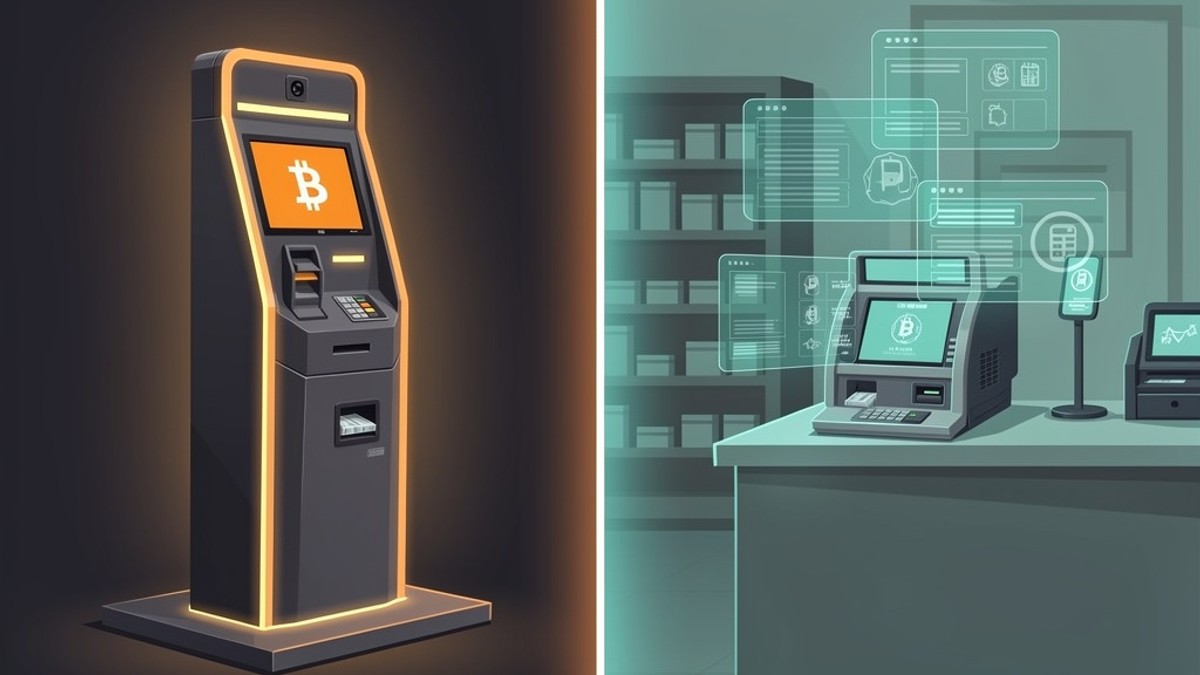
- 30,000+ LibertyX "locations" are mostly retail cashiers at CVS and Rite Aid, not Bitcoin ATMs
- ~98% are cashier counters or ATM overlays — not standalone Bitcoin kiosks
- Every transaction requires the LibertyX mobile app — no walk-up purchases possible
- NCR Atleos being acquired by Brink's for $6.6B — Brink's was fined $37M by FinCEN in 2025
- Fees are 8–9% (lower than BTMs) but multi-step process adds friction
The Bitcoin ATM industry counts more than 30,000 LibertyX "locations" among its national kiosk totals—but most of these are not Bitcoin ATMs in any meaningful sense. They are retail cashiers at CVS and Rite Aid, standard bank ATMs with a software overlay, and standalone debit kiosks running a third-party app layer.
LibertyX operates a fundamentally different model from the purpose-built, direct-settlement Bitcoin ATMs deployed by operators like Bitcoin Depot, CoinFlip, RockItCoin, Athena Bitcoin, and Byte Federal. The differences are structural—different hardware, different settlement flows, different points of failure—and they matter for consumers, regulators, and the industry's own integrity.
This is the second article in our series examining non-traditional models that get counted as "Bitcoin ATMs." The first article covered voucher-based kiosks like Coinme. LibertyX represents a third category: the software overlay.
How Direct-Settlement Bitcoin ATMs Work
A direct-settlement Bitcoin ATM is a self-contained transaction terminal. The customer approaches the machine, inserts cash, scans a Bitcoin wallet QR code, and the Bitcoin is sent on-chain—typically within minutes. One visit, one machine, one transaction. No app required. The machine handles KYC (phone verification, ID scan), wallet scanning, and payment in a single session at a single device.
Operators like Bitcoin Depot, RockItCoin, Coinhub, CoinFlip, Athena Bitcoin, Byte Federal, and America Bitcoin ATM own and deploy purpose-built hardware: bill validators, receipt printers, QR scanners, cameras for ID verification, and dedicated enclosures. The operator controls the hardware, the software, and the settlement process end-to-end.
The key characteristic: no app dependency, no intermediary, no custody gap. Customer funds are converted and delivered during the same visit. The customer leaves with Bitcoin in their wallet.
How LibertyX Works
LibertyX (legally Moon Inc., acquired by NCR Corporation in January 2022 and now part of NCR Atleos) operates a software-overlay model with three distinct location types—none of which are purpose-built Bitcoin kiosks.
The Cashier Model (Majority of Locations)
The vast majority of LibertyX's 30,000+ locations are retail cashier partnerships at CVS, Rite Aid, and independent stores. The purchase flow requires multiple steps across multiple devices:
The LibertyX Cashier Purchase Flow:
- Download the LibertyX mobile app and create an account
- Complete KYC verification in-app: name, address, date of birth; government ID for limits above $1,000/day
- Enter a Bitcoin wallet address and select a store location
- Receive a 6-digit order number displayed in the app (valid for 2 hours)
- Go to the store (CVS, Rite Aid, independent retailer) and present the order number to the cashier
- Cashier processes payment (cash at retail stores, debit card at ATM locations)
- Bitcoin is sent after payment is confirmed by the cashier and the LibertyX system
The ATM Overlay Model
For ATM-based locations, the customer enters a LibertyX order number on the ATM screen, inserts a debit card, and completes payment. The ATM is a standard bank ATM (Genmega or similar) with LibertyX software integrated—not a purpose-built Bitcoin kiosk. The LibertyX app is still required to initiate the order.
Three Location Types, One Requirement
| Location Type | Payment Method | Hardware | Human Interaction |
|---|---|---|---|
| Bitcoin Cashier (CVS, Rite Aid, independents) | Cash | Retail POS terminal | Cashier processes payment |
| Bitcoin ATM (standard ATMs with software overlay) | Debit card | Existing Genmega/other ATMs | None (ATM screen) |
| Bitcoin Kiosk (standalone debit terminals) | Debit card | Third-party debit kiosks | None |
All three models share one requirement: the LibertyX mobile app is mandatory for every transaction. There is no way to walk up to a LibertyX location and buy Bitcoin without first downloading the app, creating an account, completing verification, and generating an order number.
This is the most fundamental difference from a direct-settlement Bitcoin ATM, where the machine itself is the complete interface.
The Core Structural Differences
| Factor | LibertyX | Direct-Settlement Bitcoin ATMs |
|---|---|---|
| Smartphone app required? | Yes — mandatory for all transactions | No — machine is self-contained |
| KYC timing | Pre-transaction, in-app (before store visit) | At the machine (phone/ID scan during transaction) |
| Hardware ownership | Software on third-party ATMs and retail POS | Operator owns and deploys purpose-built kiosks |
| Settlement process | Multi-step: app → store → payment → app confirmation | Single-step: cash in → wallet scan → BTC sent |
| Supports cash purchases? | Only at cashier locations (not ATMs) | Yes — primary payment method |
| Fee range | 8–9% typical | 10–25% typical |
| Transaction limits | $500/day at chains, up to $2,999/day at independents | Varies; often $3,000–$10,000+ per day |
| Human interaction required? | Yes, at cashier locations | No |
LibertyX charges lower fees (8–9%) than many standalone BTMs (10–25%), but the multi-step process introduces friction that purpose-built machines don't have. The customer must navigate two separate systems—the app and the physical location—and coordinate between them within a 2-hour order window.
The Settlement Question: Dependencies That Don't Exist at a BTM
LibertyX claims settlement is "instant"—that Bitcoin is sent immediately once payment is confirmed by the cashier, ATM, or debit kiosk. If accurate, this is meaningfully better than the voucher model (where Coinme accumulated $8.37 million in unredeemed customer funds). LibertyX doesn't create the same "unredeemed voucher" problem because the Bitcoin address is pre-loaded in the app and settlement is automated.
But the model still introduces settlement dependencies that direct-settlement machines avoid entirely:
LibertyX Settlement Dependencies
- The app must be functioning: If the LibertyX app crashes, the phone dies, or verification fails, no transaction is possible. Consumer complaints consistently cite app failures preventing purchases.
- The cashier must cooperate: At retail locations, the cashier must know how to process the transaction. Consumer reports describe store employees unable to process LibertyX purchases—one user reported calling 8 listed locations and finding none that could complete a transaction.
- The 2-hour window must hold: LibertyX order codes expire in 2 hours. If a customer creates an order, goes to a store, pays, and the system doesn't confirm in time, the customer has paid cash with no Bitcoin delivered.
- A third-party retailer holds the cash: The money flow is: Customer → Retailer → LibertyX. Bitcoin flows: LibertyX → Customer. This creates counterparty and settlement dependencies that don't exist with a self-contained BTM.
At a direct-settlement Bitcoin ATM, there is no intermediary retailer, no app confirmation step, and no settlement chain. The customer inserts cash into a machine controlled by the operator, and the operator sends Bitcoin during the same session.
The Location Count Problem
LibertyX markets itself as "America's first and largest U.S. network of bitcoin ATMs, cashiers and kiosks" with "over 30,000 ATMs and retail stores nationwide." This claim warrants scrutiny.
What "30,000+ locations" actually means:
- Most "locations" are not ATMs: The majority are retail cashier partnerships (CVS, Rite Aid, independent stores). These are checkout counters, not Bitcoin ATMs.
- ATM overlay locations may be inactive: An ATM operator reported adding LibertyX to all their machines and seeing "zero transactions in 14 months." Users on Reddit report that listed locations frequently don't actually offer Bitcoin purchases.
- Market size inflation: When industry statistics cite total "Bitcoin ATM" counts (CoinATMRadar reports approximately 38,000 BTMs in the U.S.), it's unclear whether LibertyX's cashier network is included. If it is, the figure dramatically overstates the number of actual purpose-built Bitcoin ATMs.
This parallels the voucher kiosk inflation problem documented in our companion article about Coinme/Coinstar. Between LibertyX's cashier network and Coinme's voucher kiosks, a substantial portion of the "Bitcoin ATM market" may consist of locations that are not standalone Bitcoin kiosks in any meaningful sense.
Corporate Ownership and Regulatory Architecture
LibertyX's corporate lineage introduces its own set of regulatory and compliance considerations.
LibertyX Corporate History
The Brink's acquisition introduces a notable compliance question. In February 2025, Brink's was assessed a $37 million FinCEN penalty for willful Bank Secrecy Act violations, including failure to register as a money services business, failure to maintain an anti-money laundering program, and failure to file suspicious activity reports. LibertyX will become part of a company that FinCEN found had material compliance deficiencies.
Regulatory Licensing
LibertyX holds legitimate regulatory credentials: a New York BitLicense, money transmitter licenses in multiple states, and FinCEN MSB registration. NCR Atleos's 10-K filing states: "As a Bitcoin reseller, the LibertyX business must obtain money transmitter licenses in those states that have deemed the direct sale of Bitcoin to be 'money transmission.'"
Notably, no state enforcement actions were identified against Moon Inc./LibertyX during research for this article—a clean record that distinguishes it from several direct-settlement operators who have faced state AG lawsuits and consent orders.
The DFPI Gap
LibertyX does not appear on California's DFPI published kiosk operator location list, which includes operators like Bitcoin Depot, Coinme, Zero Hash, CoinFlip, and Athena Bitcoin. This raises questions about whether LibertyX's California operations are registered under the Digital Financial Assets Law, whether its model falls outside the DFAL's "kiosk" definition, or whether there's a regulatory gap.
Consumer Experience and Complaint Patterns
LibertyX's consumer complaint profile differs from direct-settlement BTMs in ways that reflect the structural differences in the model.
| Complaint Type | LibertyX | Direct-Settlement BTMs |
|---|---|---|
| Store can't process transaction | Common | N/A — machine is self-service |
| Account suspended without reason | Common | Less common — many BTMs allow low-value purchases without full account |
| Fee higher than advertised | Reported | Reported — common industry issue |
| Transaction failed, funds lost | Reported | Reported |
| App/software failure preventing purchase | Common (app-dependent) | Less common — hardware-based |
The LibertyX app carries a 3.2-star rating on Google Play (585 reviews), with users citing repeated verification loops, unexplained account suspensions, and wasted time. The cashier knowledge gap is a recurring theme—retail employees at CVS and Rite Aid are not Bitcoin experts and frequently don't know how to process LibertyX transactions.
One consumer reported paying $200 for Bitcoin but receiving only $121 worth—an effective fee of approximately 40%, despite LibertyX's advertised 8% rate. Reviews on BitTrust describe scammers using LibertyX to extract funds from victims under the guise of law enforcement, with LibertyX's customer support response reportedly limited to "sorry this happened."
Scam Prevention: Does the Cashier Model Help or Hurt?
One potential advantage of the LibertyX cashier model: a human being stands between the customer and the Bitcoin purchase. In theory, a trained cashier could intervene when an elderly customer seems confused or mentions being directed to buy Bitcoin by a stranger.
The reality is more complicated:
- Cashiers are not trained in fraud prevention. CVS and Rite Aid employees process hundreds of transactions per day. They are not equipped to identify or intervene in cryptocurrency scams.
- KYC happens in the app, not at the counter. By the time a customer is at the cashier, KYC is already complete. The cashier is simply processing a payment—they have no visibility into the customer's Bitcoin wallet, the destination of funds, or whether the transaction is scam-related.
- Direct-settlement BTMs are investing in on-screen intervention. Operators like Bitcoin Depot have added mandatory scam warnings, require customers to attest they own the wallet, and have implemented AI-based behavioral analysis. Byte Federal reported proactively contacting customers aged 60+ during registration and preventing over 80% of potentially fraudulent transactions.
The FTC's warning applies to all models: no legitimate business will demand advance payment through a Bitcoin ATM. This applies equally to LibertyX cashier purchases and standalone BTMs.
Three Models, Three Risk Profiles
The Bitcoin ATM industry now contains three structurally different approaches to selling Bitcoin at physical locations. Lumping them together inflates market counts and obscures meaningful differences in consumer experience and risk.
| Direct-Settlement BTM | LibertyX (Software Overlay) | Voucher Kiosk (Coinme/Coinstar) | |
|---|---|---|---|
| Hardware | Purpose-built Bitcoin kiosk | Existing retail ATM/POS with software layer | Coinstar coin-counting machine |
| App required? | No | Yes | No (but online redemption required) |
| Settlement | On-chain during visit | On-chain after app + payment confirmation | On-chain after online account creation + code redemption |
| Custody gap | Seconds | Minutes (between payment and system confirmation) | Hours to days (or never, if unredeemed) |
| Typical fees | 10–25% | 8–9% | 4–11% |
| KYC at point of sale? | Yes (at machine) | No (pre-completed in app) | No (completed online during redemption) |
| Consumer leaves with | Bitcoin in wallet | Bitcoin in wallet (after app confirmation) | Paper voucher (must redeem later) |
What Consumers and Regulators Should Know
For Consumers
Know which model you're using. If you're at a CVS and a cashier is processing your Bitcoin purchase, you're using LibertyX's software platform—not a Bitcoin ATM. The transaction depends on the app, the cashier's cooperation, and LibertyX's settlement system. If something goes wrong, the cashier can't help with your Bitcoin transaction—you must contact LibertyX support separately.
Compare total cost, not just fees. LibertyX's 8–9% fee is lower than many BTMs, but the time cost of app setup, KYC, travel to a location that may not work, and potential troubleshooting should be factored in.
For Regulators
Define "Bitcoin ATM" clearly. If a CVS cashier processing a LibertyX barcode counts as a "Bitcoin ATM location," the term loses meaning. Regulators should distinguish between purpose-built kiosks and software overlays on existing retail infrastructure. LibertyX's absence from the California DFPI kiosk operator location list warrants investigation—either its model falls outside the DFAL's "kiosk" definition, or there's a regulatory gap.
Compliance responsibility at the point of sale. When a Bitcoin purchase happens through a third-party cashier at a national retail chain, regulatory responsibility becomes diffuse. Who monitors for suspicious activity—the retailer, the ATM operator, or LibertyX?
For the Industry
Location count transparency. Industry bodies and data providers should distinguish between direct-settlement kiosks, voucher kiosks, and software-overlay locations when reporting "Bitcoin ATM" totals. Lumping all three together inflates the market and misleads consumers, investors, and regulators.
Why this site excludes LibertyX from listings: BitcoinATM.news lists only direct-settlement Bitcoin ATMs—machines that deliver cryptocurrency to the customer's wallet during the same visit using purpose-built hardware. LibertyX cashier locations, ATM overlays, and debit kiosks are excluded because they rely on third-party hardware, require a mandatory mobile app, and don't provide the standalone, self-service Bitcoin purchasing experience that the term "Bitcoin ATM" implies.
Neither LibertyX nor direct-settlement operators are free of criticism. Both face legitimate questions about fees, scam facilitation, and consumer protection. But they are structurally different products serving the same market, and conflating them distorts the picture for everyone involved.
A CVS cashier scanning a barcode is not the same thing as a purpose-built kiosk dispensing Bitcoin. The industry should stop counting them as if they were.
Continue your location research
Use the directory and source-backed state guides connected to this reporting.