
$2,000/day
New Customer Limit (First 3 Days)
$5,000/day
Established Customer Limit
$2,500
Fine Per Violation
90%+
Utah Kiosk Transactions Tied to Scams (Per Investigation)
Who Pushed This Law — and Who Pays the Price
HB 72 didn't emerge from abstract policy debate. Its path to the governor's desk was paved substantially by AARP lobbying and a vocal coalition of elderly scam victims and their families. This is a well-organized and deeply sympathetic advocacy group, and their testimony was devastating — stories of retirees losing life savings to fraudsters who coached them through Bitcoin ATM transactions. No legislator wants to vote against protecting grandparents.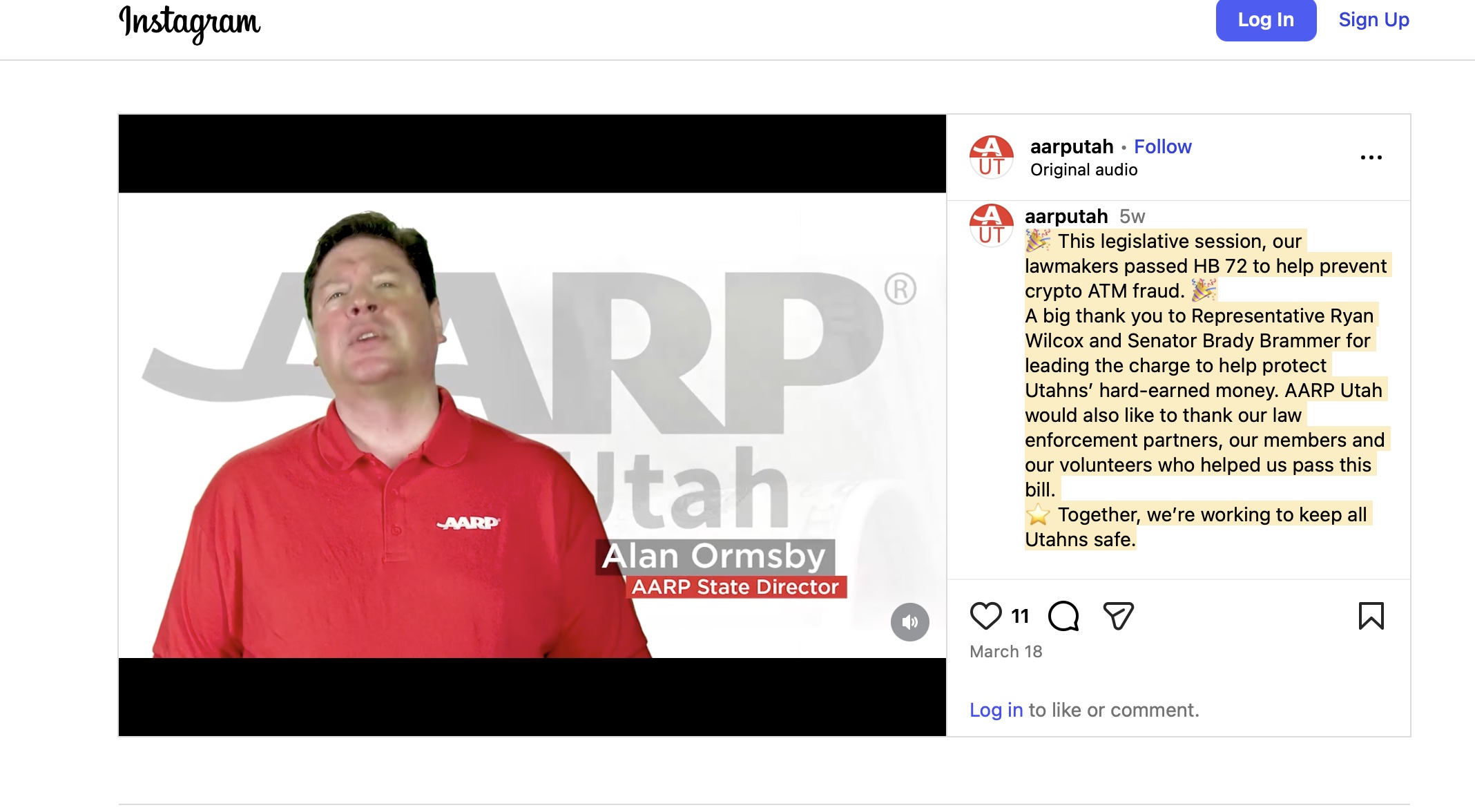
"An elderly Utah man was scammed into feeding roughly $50,000 in cash into Bitcoin ATMs over a period of weeks."
— Example cited in Utah legislative hearings on HB 72
The Core Tension:
- Scam victims are overwhelmingly new, one-time users — the $2,000 first-three-day cap directly addresses this group.
- Repeat, established customers — the super majority of Bitcoin ATM users — are extremely unlikely scam victims, yet they now face a permanent $5,000 daily cap.
- The law was driven by AARP lobbying and elderly victim testimony — a vocal and sympathetic minority whose experience, while devastating, does not reflect how most people use these machines.
- The graduated structure was an industry-negotiated compromise. Without it, Utah might have joined the ban camp.
What the Law Actually Requires
HB 72 creates a new chapter in Utah code — Title 13, Chapter 82, Virtual Currency Kiosk Regulation — and imposes requirements across five categories: transaction limits, disclosures, fraud prevention, recordkeeping, and enforcement cooperation. It also requires all crypto kiosk operators to obtain a money transmitter license and register every machine with the state — formalizing a requirement that FinCEN already imposes at the federal level under the Bank Secrecy Act but that many states have been slow to codify specifically for kiosks.Graduated Transaction Limits
The bill's most operationally significant provision is a two-tier daily cap system. During the three calendar days following a customer's first-ever transaction with an operator, that customer cannot transact more than $2,000 in cash (or virtual currency equivalent) per calendar day. After that three-day introductory period, the daily limit rises to $5,000. Under these limits, a new customer could deposit no more than $6,000 total in their first three days ($2,000 × 3). The elderly victim described in testimony lost $50,000 — a sum that would now take at minimum 12 days to reach even at maximum daily limits, dramatically expanding the window for family members, bank staff, or law enforcement to intervene. That's the strongest argument for the limits. The weakest argument is applying the $5,000 cap permanently to someone who has been using the same operator's kiosks for two years without incident. The structure reflects industry negotiation. The graduated approach replaced earlier, more restrictive proposals and was specifically designed so that the tighter cap falls on the window when scam vulnerability is highest — those first few days when a fraudster is actively coaching the victim. Whether $5,000 is the right permanent ceiling for established users is debatable, but the tiered logic is sound from a fraud-prevention standpoint for the introductory period.Fraud Prevention Warnings
Every kiosk must display a prominent fraud prevention warning in both English and Spanish. The warning must communicate that cryptocurrency transactions are irreversible and that no government official will ever demand payment via a cryptocurrency machine. The bilingual requirement reflects the demographics of Bitcoin ATM users in Utah and the reality that scammers target non-English-speaking victims.Disclosure and Receipt Requirements
Operators must provide all disclosures in the customer's chosen language. Each transaction must generate a receipt showing the transaction hash, fees charged, exchange rate applied, and the operator's refund policy. These aren't optional add-ons — they're statutory requirements enforceable by fine.Customer Service and Recordkeeping
The law mandates a toll-free customer service line. Operators must maintain complete transaction and customer records. The combination serves dual purposes: giving scam victims a way to report fraud immediately and giving law enforcement a data trail to follow.Location Reporting and Blockchain Analytics
Operators must file annual reports with the state listing every kiosk location in Utah. They must also provide 30-day notice after installing or removing a kiosk. This creates a state registry of every Bitcoin ATM — something most states lack entirely. The enrolled bill also requires operators to implement blockchain analytics tools to block transactions to known fraudulent wallet addresses (Section 7-29-203(2)). This pushes compliance beyond traditional know-your-customer checks into active transaction monitoring — a capability that larger operators already use but smaller ones may struggle to implement.Full Requirements Under HB 72 (Effective May 6, 2026):
- Transaction limits: $2,000/day for first 3 days; $5,000/day thereafter
- Fraud warnings: Prominent display in English and Spanish on every kiosk
- Disclosures: Provided in the customer's chosen language
- Receipts: Must include transaction hash, fees, exchange rate, and refund policy
- Customer service: Toll-free phone line required
- Records: Complete transaction and customer records; law enforcement cooperation mandated
- Location reporting: Annual reports plus 30-day notice for installations or removals
- Blockchain analytics: Must block transactions to known fraudulent addresses
- Licensing: Money transmitter license required; every machine registered with the state
Enforcement and Penalties
Utah places enforcement authority with the Division of Consumer Protection rather than a banking regulator — a choice that signals the legislature views Bitcoin ATMs primarily as a consumer protection issue, not a financial services licensing question.Penalty Structure Under HB 72
1
Administrative Fine
The Division of Consumer Protection may impose up to $2,500 for each violation, without court involvement.
2
Court-Imposed Civil Penalty
A court may impose up to $2,500 for each violation in a civil enforcement action.
3
Order Violation Penalty
Violation of an administrative or court order subjects the operator to up to $5,000 for each subsequent violation — effectively doubling the penalty for operators who ignore initial enforcement actions.
How Utah Compares to Other States
Utah's approach arrives during the most active period of state-level Bitcoin ATM regulation in the industry's history. The landscape is splitting into three camps:State-by-State Comparison: Bitcoin ATM Regulation (April 2026)
- Ban states: Indiana and Tennessee have enacted outright prohibitions. Minnesota's ban bill has passed both chambers.
- Heavy regulation states: Utah (HB 72), South Dakota (SB 98), and Rhode Island have enacted detailed operational frameworks with transaction limits, disclosure requirements, and enforcement mechanisms.
- Flat daily cap states: Arizona and Wisconsin impose flat $2,000 daily caps with no escalation.
- Light or no regulation states: Many states still rely only on federal MSB requirements and general consumer protection statutes.
What This Means for Utah Bitcoin ATM Users
What Changes for You After May 6, 2026:
- Your first three days are capped at $2,000/day. If you've never used a particular operator's kiosks before, you cannot transact more than $2,000 in cash or crypto per calendar day for three days.
- After three days, your daily limit is $5,000. This applies per operator — using a different company's kiosk resets the clock.
- You'll see fraud warnings in English and Spanish on every machine, stating that crypto transactions are irreversible and no government official will ever ask you to pay via a kiosk.
- You'll get real receipts showing the transaction hash, fees, exchange rate, and refund policy.
- You can call someone. Every operator must maintain a toll-free customer service line. If you believe you've been scammed, call immediately.
- Disclosures must be in your chosen language, not just English.
- If someone is pressuring you to deposit cash at a Bitcoin ATM, stop. Visit our consumer protection resources or call the Utah Division of Consumer Protection.
What This Means for Operators
May 6 is nine days away. Operators with kiosks in Utah face an immediate compliance checklist:Operator Compliance Checklist — Due May 6, 2026:
- Transaction limit enforcement: Systems must distinguish new customers from established ones and enforce the $2,000/$5,000 graduated caps per calendar day across all of your Utah kiosks. If a customer uses your kiosk in Provo and then walks into another of your machines in Salt Lake City, your system must recognize that customer and enforce the cumulative daily cap.
- Fraud warning signage: Install prominent English and Spanish fraud prevention warnings on every Utah kiosk by May 6.
- Multi-language disclosures: Ensure all disclosures can be displayed in the customer's chosen language.
- Receipt generation: Confirm receipts include transaction hash, fees, exchange rate, and your refund policy.
- Toll-free customer service line: Establish or verify a working toll-free number — this must be operational, not just listed.
- Blockchain analytics: Deploy tools to screen and block transactions to known fraudulent wallet addresses.
- Location reporting: Prepare to report every Utah kiosk location to the Division of Consumer Protection annually. Implement a process to notify the state within 30 days of adding or removing any kiosk.
- Money transmitter license: Confirm valid Utah licensure. Operating without one exposes you to additional regulatory action.
- Recordkeeping and law enforcement cooperation: Maintain complete transaction and customer records. Formalize processes for responding to investigations.
The Bigger Picture: Regulation vs. Prohibition
Utah's approach is significant precisely because it isn't a ban. At a moment when Tennessee has criminalized Bitcoin ATMs, Minnesota is advancing prohibition legislation, and at least one more state has a ban bill on a governor's desk, Utah chose to regulate the industry rather than eliminate it. That choice carries an implicit bet: that fraud warnings, transaction limits, blockchain screening, and enforcement penalties can reduce scam losses without eliminating consumer access to crypto kiosks. The test of that theory is whether operators actually comply and whether the Division of Consumer Protection enforces the rules aggressively enough to matter. A law with $2,500 fines but no enforcement staff is just paper. A law backed by consistent inspection and meaningful penalties could become a model for states still deciding between regulation and prohibition. But there's a harder question embedded in Utah's law that no state has grappled with honestly: how much should the majority of users be restricted to protect a vulnerable minority? The 90% scam figure cited in legislative hearings is alarming, but even if accurate, it measures the share of money flowing through kiosks that was scam-related — not the share of users who are victims. Most scam victims use a kiosk once, lose money, and never return. The repeat, established customers who make up the ongoing user base are a fundamentally different population with fundamentally different risk profiles. The graduated limit structure acknowledges this distinction — $2,000 for new users, $5,000 for established ones — but the permanent cap on established users suggests the legislature wasn't fully persuaded by its own logic. States watching Utah's experiment include New Hampshire, where the House recently rejected a pro-industry amendment to its own crypto ATM scam bill, and South Dakota, which passed its own detailed regulatory framework. If Utah's fraud numbers improve measurably after May 6, the regulation model gains credibility as an alternative to the bans sweeping other states. If operators skirt the rules and enforcement is thin, it becomes ammunition for the prohibition camp. The question every operator in Utah should be asking: when the Division of Consumer Protection starts reviewing annual location reports and transaction data after May 6, what will it find? And the question every regular Bitcoin ATM user should be asking: who was in the room when these limits were set — and why wasn't anyone there representing you?Note: No official press release or statement from the Utah governor's office has been located alongside the enrolled bill. The enrolled text is published on the Utah Legislature's website and the bill was signed March 25, 2026.
